
A fully committed boxing camp or Muay Thai camp will tell you that specialisation is the answer. Spend two years exclusively on one art, they’ll say, and you’ll have a foundation worth building on. For a competitor in that specific sport, they’re right. For an MMA striker trying to become dangerous on their feet, that advice produces fighters who are excellent at one dimension of a problem that has at least three.
MMA striking is not boxing. It’s not Muay Thai either. It’s a distinct problem set that borrows heavily from both and is fully solved by neither. The argument here isn’t that you need to dabble in everything. It’s that the specific gaps boxing leaves are filled almost perfectly by Muay Thai, and the specific gaps Muay Thai leaves are filled almost perfectly by boxing. That overlap is not a coincidence. It’s the reason fighters like Anderson Silva, Conor McGregor, Israel Adesanya, and Joanna Jedrzejczyk all built their games on both foundations.
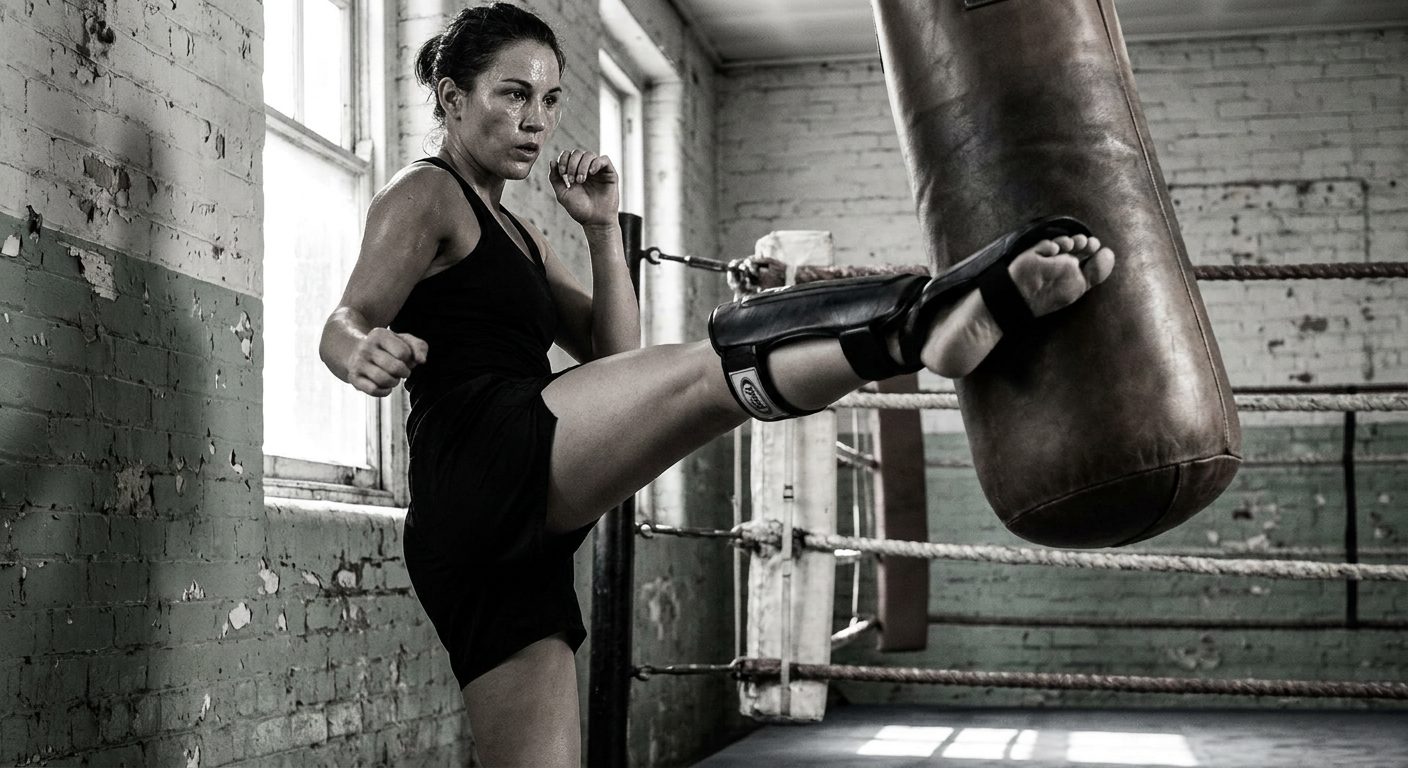
What Boxing Gives You That Muay Thai Alone Cannot
Muay Thai hand technique is functional inside its own ruleset. The guard is high, the stance is square, the punches are often short and economical because clinch entries matter more than pure punching output. Against another Muay Thai fighter, this is fine. Against a trained boxer in an MMA context, it creates a specific problem: you cannot punch fast enough to prevent entry, and your head movement is minimal.
Boxing’s core gift to an MMA striker is two-fold. Punch volume and timing, and the head movement that makes you hard to hit back. Coaches like Freddie Roach, who has worked with Manny Pacquiao and has spent years adapting boxing technique for MMA fighters, specifically identified punch volume as the gap. Muay Thai fighters throw fewer punches per exchange because they’re conserving energy for kicks, elbows, and clinch. In MMA, where takedowns are always in play, shorter exchanges are smart. But when a pure boxing exchange opens up, a Muay Thai-trained striker will often lose it because they haven’t thrown five-punch combinations ten thousand times at boxing-specific speed.
Head movement is the other piece. Pure Muay Thai discourages ducking and weaving because those positions expose you to knee strikes and can compromise your upright kicking base. The style rewards staying tall. Boxing teaches you to make yourself difficult to hit at all times, slipping left and right, rolling under hooks, pulling out of range. An MMA fighter who can do both, who can slip and counter like a boxer but reset to an upright posture for kicks, is harder to prepare for than one who does either in isolation. Israel Adesanya is probably the best modern example. His boxing-trained head movement is the reason so many of his counter shots land clean while his opponents’ follow-up strikes miss.
What Muay Thai Gives You That Boxing Alone Cannot
Take a pure boxer and put them in an MMA context. Their hands are fast, their footwork is good, and they can take a punch. But they have limited answer for a leg kick. None at all for an elbow inside the clinch. Their teep distance management is nonexistent, so their opponent can time entries and set distance however they want. And in the clinch, which is where MMA often ends up before a takedown attempt, they have no offensive weapons and limited experience at all.
Leg kicks change the entire equation of how a striking contest gets fought. Conor McGregor’s fight against Dustin Poirier in their rematch showed exactly what a skilled leg kick game does to a pure boxing base. McGregor’s boxing was still sharp. His timing was still there. But once Poirier started targeting the lead leg, McGregor’s footwork broke down, his combinations slowed, and the whole architectural structure of his striking game collapsed because it was built on a foundation that hadn’t absorbed sustained leg attack.
Muay Thai also teaches you to fight from different ranges simultaneously. A boxing contest is fought at punching range or outside it. A Muay Thai contest is fought at kicking range, punching range, and clinch range, and transitions happen continuously between them. For MMA, where a grappler can pull you into the clinch whenever they want, being comfortable and dangerous at that mid-to-close range is not optional. The teep, Muay Thai’s straight push kick, is specifically what creates and maintains the distance at which punching is effective. Thai fighters use it the way boxers use the jab: as a range-finder, a disruptor, and a fight-control tool. Without it, you’re letting your opponent choose the distance.
Elbows are a weapon that has no equivalent in boxing. Inside the clinch, against the ropes, after a parried punch, the elbow is devastating and available precisely when punches are too short. Joanna Jedrzejczyk built much of her pressure game around elbow timing in the pocket, where her pure boxing would have run out of real estate.
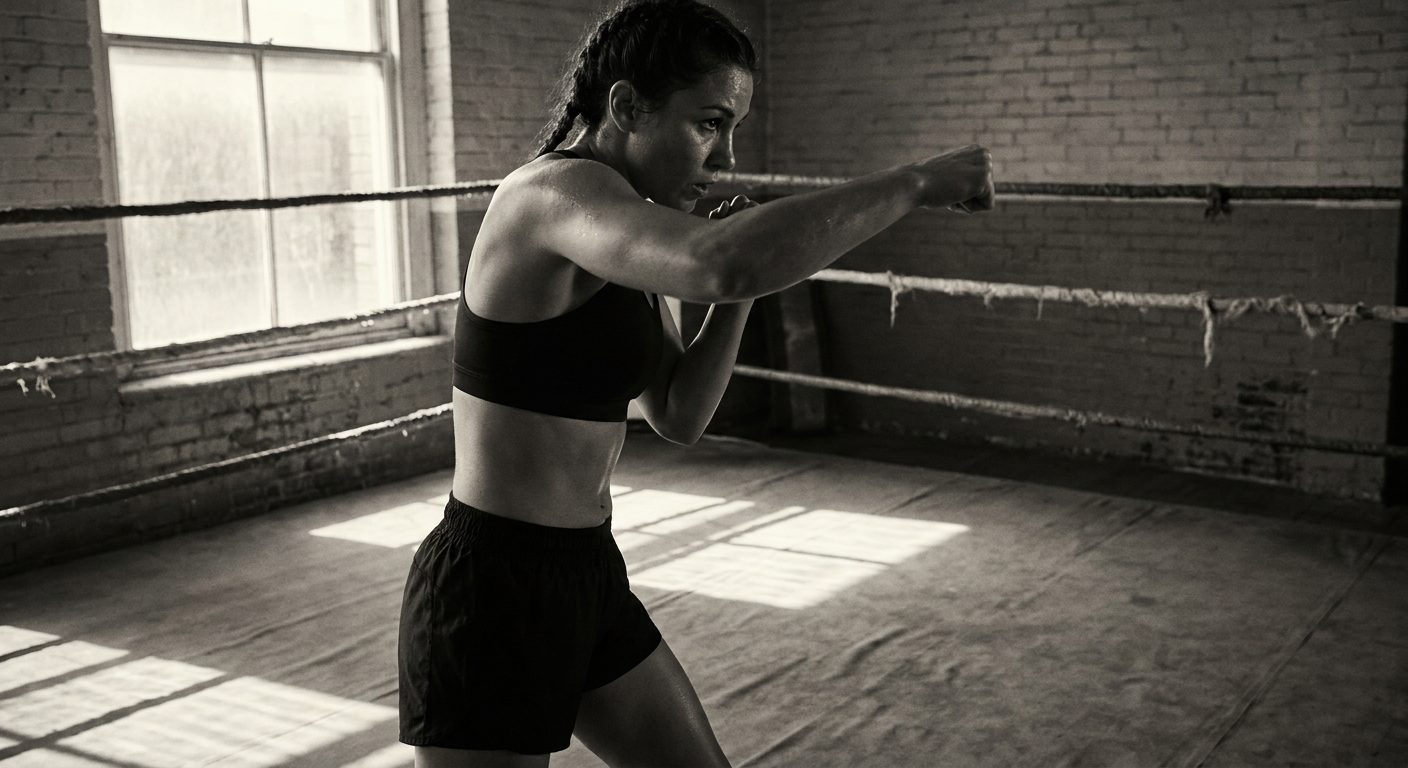
Why the Two Arts Don’t Fully Substitute for Each Other
There’s a version of this argument that says you should just pick the better one. If Muay Thai has more weapons, learn Muay Thai. But the weapons argument misses the conditioning gap. Boxing develops a very specific kind of punch timing, combination speed, and defensive reflex that Muay Thai training does not replicate at the same intensity, because Muay Thai training distributes its attention across the entire range of weapons. A dedicated boxing sparring session, three rounds of pure punching exchanges at meaningful intensity, builds punch-specific reflexes that a Muay Thai camp simply doesn’t program for at the same frequency.
The same applies in reverse. Leg kick defense, the leg check, the catch-and-trip, the reaction to a body kick in Muay Thai, these are reflexes. You don’t acquire them by thinking about them. You acquire them by getting leg kicked hundreds of times until the check becomes automatic. A camp that never throws leg kicks is not preparing its fighters to defend them.
This is why the best MMA striking coaches, people like Jason Parillo who worked extensively with B.J. Penn and Cung Le, tend to structure their programs with dedicated boxing blocks and dedicated Muay Thai blocks rather than a blended hybrid session for every training day. The arts develop different motor patterns, and those motor patterns need to be drilled in their native context before they can be intelligently combined. Trying to learn both simultaneously in a hybrid class is the slowest path to competence in either.
If your training includes timed rounds, a structured round timer like the one at heavybag.pro/boxingtimer/ lets you program boxing-specific intervals separate from your Muay Thai sessions. Three-minute rounds for boxing, two-minute rounds for Muay Thai sparring with rest intervals that match each art’s typical competition format. It sounds like a small detail until you’ve trained both and noticed how much the round structure affects pacing and output.
The Practical Question: Which One First?
For most MMA-focused fighters starting from scratch, boxing first makes sense. The hand speed, the punch-defense reflexes, and the footwork fundamentals transfer directly into every other striking art. Kru Mark Dellagrotte, who trained Georges St-Pierre’s striking for much of his dominant run at welterweight, has spoken about this sequencing repeatedly: boxing creates the neuro-muscular base that everything else gets layered onto.
That said, there’s an argument for Muay Thai first for fighters who are naturally punching-oriented, because Muay Thai will force them to develop weapons they’d otherwise ignore. A fighter who loves to box needs to be dragged into kicks and the clinch, and starting in a Muay Thai environment does that by default.
What doesn’t work is staying in one art indefinitely. Fighters who spend their first five years exclusively in a boxing gym and then add Muay Thai late often have deeply ingrained defensive reflexes, like the head-down roll under hooks, that actively conflict with safe Muay Thai positioning. The longer the boxing habit runs, the more re-programming the Muay Thai transition requires. The reverse is also true: a long-term Muay Thai fighter bringing in a boxing coach often has to rebuild punch output and head movement from near zero because the Muay Thai guard was never optimized for it.
The conclusion isn’t a number of months or a specific split. It’s that both arts need dedicated time, not token cross-training, and the fighter who shortchanges either one will eventually find the gap when they run into someone who didn’t. See also: how boxers and kickboxers pressure each other differently, and the kickboxing vs. Muay Thai breakdown for more on how striking arts diverge in practice.
For a more detailed look at what carries over between arts, this breakdown of boxing-to-Muay-Thai skill transfer goes deeper on the specific techniques that translate and the ones that need relearning from scratch. The short version: footwork transfers well, punch defense transfers partially, kick defense and elbow range do not transfer at all and must be built from scratch in the appropriate context.
Build your striking on both foundations. The fighters who do are harder to prepare for, because they don’t have a single-system gap that a smart opponent can exploit. The Heavy Bag Pro app has structured round formats for both boxing and Muay Thai training blocks, which makes it easier to maintain dedicated sessions in each art without losing the separation that makes the training effective.