
I’ve spent a lot of rounds standing next to coaches watching fights, and the thing that struck me early on was how little they seemed to care about the punches that landed. They were watching other things: the guy’s left shoulder before the cross, the way his lead foot planted wide before a power shot, the half-step he took every time he wanted to clinch. By round three they knew the whole playbook. By round four they were telling their fighter exactly where the shots were coming from.
Watching boxing like that is a learnable skill. It has nothing to do with years of experience. It has everything to do with knowing what to look for, and then training your eye to see it fast. This guide is about that.
Why Most Fight Fans Watch the Wrong Thing
When you watch a fight and you’re not trained, your eye goes where the action is loudest: the shot that lands, the wobble, the knockdown. You’re chasing the result. Coaches and trained fighters watch the setup: what happened ten frames before the result. The shot that lands is almost never the interesting moment. What’s interesting is the sequence that created the opening for it.
Rafael Cordeiro, the Sequóia MMA trainer who has worked with names like Fabricio Werdum and Cris Cyborg, has talked about how fighters who study film obsessively learn to see the shoulder before the punch. Not the punch. The shoulder. Because by the time the punch arrives, it’s too late to do anything. The tells are what save you, and they’re also what give you opportunities.
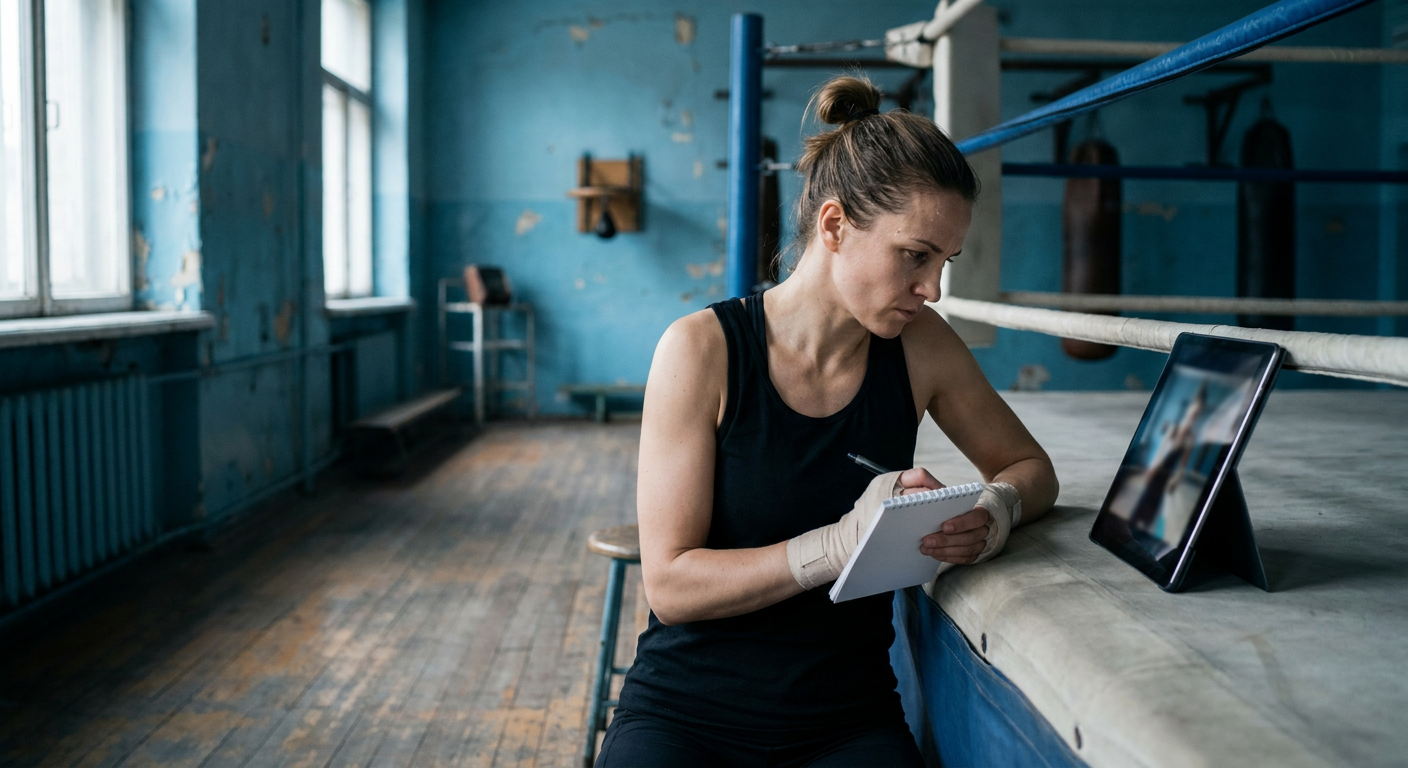
One practical way to build this habit: use a structured timer during film study. The free boxing round timer at heavybag.pro lets you set custom intervals, so you can watch in focused two-minute blocks, then pause for thirty seconds to note what you saw. A discipline borrowed from how professional corners break down tape.
The Shoulder Tell: Reading Power Shots Before They Arrive
Every hard cross loads the same way. The rear shoulder drops slightly and rotates back. On a big shot, that rotation is visible a fraction of a second before the punch launches. It’s subtle on a skilled fighter, obvious on a beginner. Either way, it’s there.

Sit with any elite boxing match and pick one fighter. Watch nothing but that rear shoulder for three rounds. You’ll start seeing the telegraph for every major power shot. Bernard Hopkins was famous for reading this tell in opponents. Watch his fights against Joe Calzaghe or Antonio Tarver and you’ll see him slipping away from crosses before they’re even halfway extended, because he was responding to the shoulder load, not the punch itself.
The same rule applies to hooks. The elbow lifts before the hip turns. Lead hooks from aggressive fighters often come with a half-step or weight transfer that’s readable a beat ahead. Once you can see it on tape, you start seeing it in sparring. Once you see it in sparring, you stop eating hooks.
Footwork as the Real Fight Narrative
Most televised fights don’t show the feet well enough. The broadcast directors cut to wide shots during flurries and zoom in on faces for reactions. This is fine entertainment and useless for studying footwork. When you study fights for coaching purposes, you need to watch the feet.
A few things to look for: where the lead foot lands after a combination (is the fighter in position to defend, or has the offensive push left them flat-footed?), whether the back foot pivots on power shots (if it doesn’t, the power is coming from the arm only), and how the fighter moves after a miss (some fighters step through and recover cleanly; others freeze for a fraction of a second, which is when counters land).
The Dutch kickboxing tradition is particularly instructive here. Watch older fights from fighters who came up through the Amsterdam gyms, names like Ernesto Hoost or Bas Rutten. The footwork in Dutch-trained fighters is built around load and recovery, a very specific rhythm of step-punch-reset that becomes readable once you know to look for it. When it breaks, you see exactly where the fighter is in trouble.
Reading the Guard: What Dropped Hands Actually Mean
A dropped guard late in a fight is fatigue. A dropped guard early is either confidence or a deliberate style choice, and you need to know which. This matters because the countermeasure for each is different.
Watch this breakdown of when dropping the guard is a trap versus a mistake. Fighters like Roy Jones Jr. built entire careers around holding a low guard that invited attacks and then made opponents miss catastrophically. If you’re coaching someone who keeps catching a low-guard fighter flush, the answer isn’t “punch to the open face.” The answer is to understand that the guard position is part of the defensive system.
What tells you the difference? Timing and response. A confident low guard looks the same in round one and round nine. A fatigued dropped guard shows up in round seven and the hands come back up slower each time. The chin response also changes: a confident fighter controls their chin position even with low hands; a fatigued fighter’s head gets stationary and forward, a different body language entirely.
Jab Patterns: The Fight Within the Fight
The jab tells you more about a fighter’s intentions than anything else they throw. Coaches who study tape spend significant time on nothing but jab sequences, because the jab is how a fighter establishes distance, tests reactions, sets up their power hand, and checks whether the opponent is respecting range.
Three jab patterns worth learning to recognize:
The range-finder jab: Low commitment, often short of landing. The fighter is calibrating distance and watching how the opponent responds. Do they step back? Shell up? Blink? This jab isn’t meant to do damage; it’s an information-gathering tool.
The setup jab: This one lands, or nearly does. The fighter is looking for the hand response. If the opponent’s right hand comes up to parry, the cross to the body is open. If the head moves back, the jab will be repeated at a longer reach to freeze the movement, and then the cross finds the chin while it’s still elevated from the rear lean.
The punishing jab: Slower fighters use this. Multiple jabs in sequence, looking for accumulated damage rather than setups. An orthodox fighter using a punishing jab rhythm often wants to stay on the outside and not get drawn into exchanges. When you see this pattern, watch for the opponent’s corner adjusting: they’ll usually push their fighter to close distance and negate the reach advantage.

When to Watch the Feet vs. When to Watch the Hands
If you try to watch everything at once, you’ll see nothing clearly. Seasoned corner people switch their attention deliberately based on what phase of the fight they’re in. Here’s a rough practical split.
Watch the feet: at the start of exchanges (who’s establishing position?), after missed shots (what’s the recovery?), and during clinch breaks (where does the fighter end up relative to the ropes?).
Watch the hands: during mid-combo, for trigger tells (the shoulder drop, the elbow lift), and when a fighter resets to guard after a combination. The reset is where mistakes happen, where the guard comes back wrong or the chin is briefly exposed.
Watch the head: for pain signals (teeth together, neck stiffening, sudden clinch attempts), for defensive habits under pressure (some fighters always tuck to one side; this is a readable pattern for opponents), and for reaction to feints (a fighter who bites on every feint is about to have a long night).
Using the Heavy Bag App During Film Study
One thing that transfers directly from fight study to bag work: you can isolate a tell you’ve spotted in tape and then drill the response on the bag. If you’ve noticed that a fighter’s rear shoulder drops before the cross, spend a round shadowboxing with a partner calling out “cross” randomly, and practice slipping before the full extension lands.
The Heavy Bag Pro app has round structures specifically built for drilling single-concept work. Set a thirty-second work interval, a ten-second note pause, repeat. It matches the film-study rhythm described earlier and keeps you from drifting into unfocused rounds where you’re just going through the motions. If you’re doing this kind of focused technical work, short sharp rounds beat long sloppy ones every time.
What the Corner Sees That You Miss
Corners track two things over rounds that viewers rarely notice: the trend, and the exception to the trend.
The trend is what the fighter keeps doing. If the right hand is coming back slower to guard after every combination, that’s a trend. If the footwork is deteriorating to straight back-and-forth by round five when it started lateral, that’s a trend. Trends are what corners adjust strategy around at the end of rounds.
The exception is the tell that a fighter breaks from their own pattern. A methodical boxer who suddenly throws a wild wide hook in the fifth round is either desperate, hurt, or setting something up. Each of those reads differently. Desperate looks rushed, the combo cut short afterward. Hurt looks like the clip-and-cover that follows, or a sudden clinch. Setting something up means the same “mistake” gets repeated with slightly different follow-up each time, until the opponent bites.
That gap between trend and exception is where elite cornering lives. Angelo Dundee was famous for identifying exceptions in real time and adjusting mid-round through the bucket on the ring floor if he couldn’t wait for the break. His notes from Ali’s fights are a masterclass in the gap between “this is what’s happening” and “this is what matters.”
A Simple Framework for Watching Your Next Fight
Pick one fighter. Watch them only. Ignore the other person for the first five minutes.
Write down three things you notice about their jab pattern. Then write down where their guard sits between combinations, not during, but in the half-second after the last punch lands and before they reset. Then note what they do when they miss a shot: step through, freeze, or clinch?
After three rounds of focused watching, you will have spotted at least one habit that a good opponent would exploit. That’s how corners watch fights. Not looking for mistakes; looking for patterns, because patterns become predictable, and predictable opponents get hurt.
Also worth doing: watch the same fight twice. The first time, follow the action. The second time, watch only the footwork, sound off. You’ll see a completely different contest.
If you want to tie this directly into your own training, building the analytical habit outside the ring is one of the fastest ways to improve your confidence inside it. Understanding how fights work technically changes how you feel walking into a hard round.
Worth knowing: research on anticipatory cue reading in combat sports consistently shows that trained observers identify action-relevant cues significantly faster than untrained ones, and that the skill improves with deliberate practice. Coaches have been acting on this intuition for decades; sports science is catching up.