
Your first kick will be terrible. Not bad-but-fixable terrible, either. We’re talking wobble, stumble, and a hip that stays completely glued to the wall while your foot flaps at the bag like a wet towel. That’s normal. The question isn’t whether your first kick looks ridiculous. It’s whether you understand what’s going wrong and how to correct it before the stumbling becomes a habit.
Boxers come into kicking with one major hidden disadvantage: the footwork they’ve spent months drilling works against them. A boxing stance is designed to keep you planted, lateral, and square enough to punch and exit fast. A kicking stance — at least a Muay Thai roundhouse — asks you to transfer weight through the hip, pivot the base foot, and commit to a rotation that a boxing coach would call overcommitted. The instinct trained into you for punching is actively fighting the instinct you need for kicking.
This article covers the specific mechanical conflicts boxers hit when they throw their first roundhouse, what coaches at gyms like Fairtex and traditional American boxing crossover classes consistently flag as the primary faults, and the drills that build a functional kick without untraining your boxing foundation.

Why the boxing stance fights the roundhouse
A standard orthodox boxing guard keeps the lead foot angled roughly toward the opponent and the rear foot turned slightly outward for power transfer on the cross. The weight distribution is balanced and mobile. That setup is built for walking punches out, not for pivoting hard through the hip.
A roundhouse kick from the rear leg — the most common starter kick — requires the base (lead) foot to pivot outward so the heel swings toward the target. That pivot opens the hip for rotation. If the lead foot doesn’t pivot, the hip can’t open far enough to generate meaningful hip snap, and the kick becomes all shin and no body behind it. Boxers, trained to keep their lead foot tracking forward, resist that pivot. The foot wants to stay put. The hip stays closed. The kick lands with zero rotation behind it.
Add to that the head position. Boxers are trained to keep the chin down and the guard up during any offensive exchange. When throwing a roundhouse, your body rotation wants to pull the shoulder back and the head with it. The result is a boxer who either keeps their chin tucked and kills their own hip rotation, or who suddenly opens up and throws their hands down mid-kick without knowing why. Neither version works.

The actual mechanics, broken down without the Muay Thai jargon
Kru Phil Nurse, who trained boxers crossing into MMA for years, used to describe the roundhouse to boxing-trained fighters as “a punch with your shin.” The comparison is deliberately imprecise but useful: you’re not dropping a leg on someone, you’re driving through them with a rotating weapon. The shin is the knuckle. The hip is the shoulder. The pivot is the hip-turn you already use on the cross.
That framing helps because boxers already have the motor pattern for hip rotation — they use it on every cross they throw. The lead hip drives forward and the rear hip rotates through. The kick just does the same rotation but redirects it upward and outward through the shin instead of forward through the fist.
Here’s the sequence in plain terms:
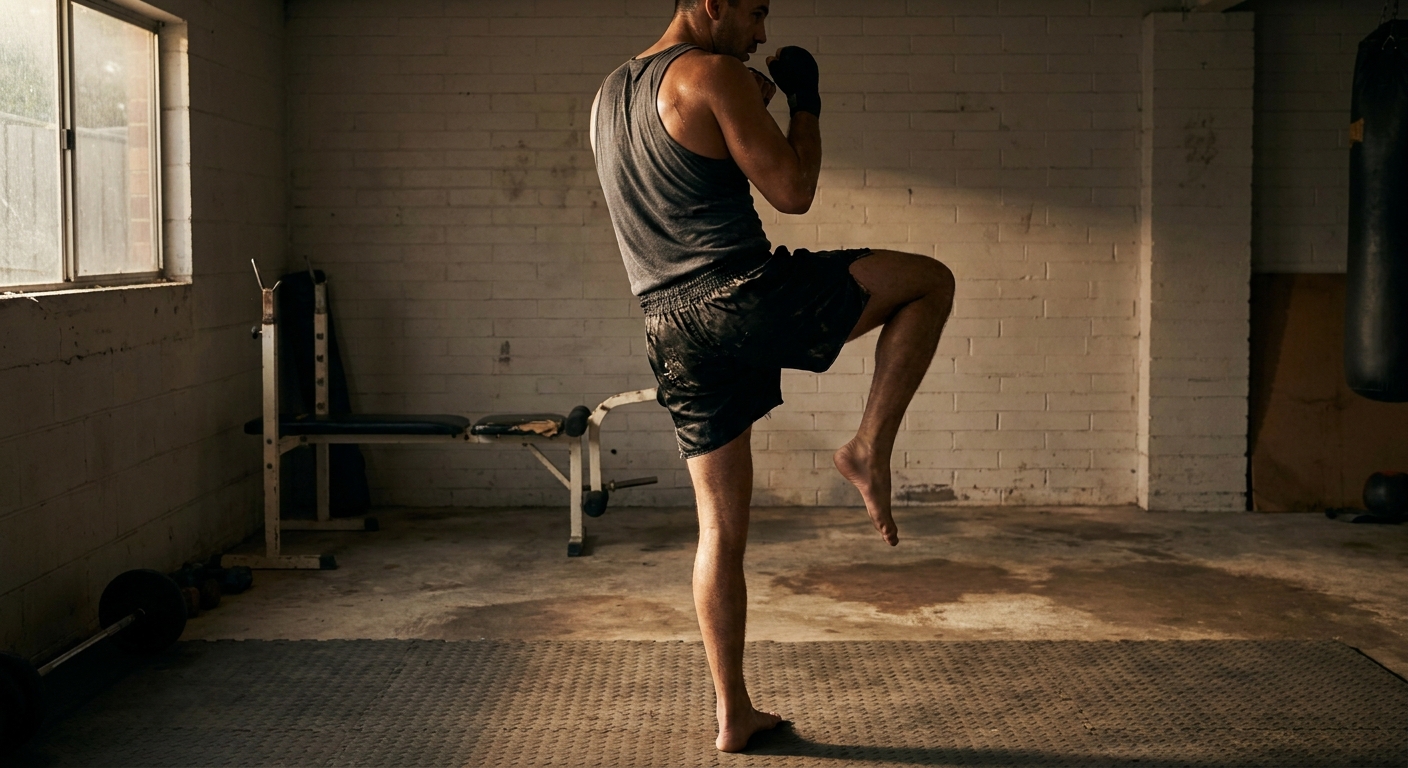
- Chamber. Lift the rear knee to roughly hip height. The knee stays bent. Don’t extend yet.
- Pivot the base foot. The lead foot swings heel-outward as the knee comes up. This is the part boxers consistently skip. Without it, the hip stays locked and the kick has no power source.
- Drive the hip through. The rear hip rotates forward and the leg extends at the target from the knee down. Contact is with the lower shin, not the foot.
- Return through chamber. The leg doesn’t fall straight down. It comes back through the raised-knee position before you reset. Skip this and you land flat-footed with your weight on the wrong foot.
The part that makes boxers fall over — literally, sometimes — is that they pivot the base foot wrong. Some don’t pivot at all. Others pivot but don’t shift weight over the base leg first, so the pivot becomes a spin with nothing under them. Before you even think about throwing the kick, practice pivoting with no kick attached: stand in your boxing stance, lift the rear knee slowly, and swing your lead heel outward until you feel the hip begin to open. Do that twenty times before you add the extension.
The balance problem and what’s causing it
Falling over on your first kick doesn’t mean your balance is bad. It means your weight was in the wrong place before the kick started. Boxers tend to sit back on the rear foot between combinations — it’s a defensive habit that protects against counters. But kicking from the rear leg requires weight shifted slightly over the lead foot so the rear leg is free to chamber.
If you launch a rear roundhouse without shifting weight first, you’re essentially trying to pick up a leg that’s still supporting half your bodyweight. The kick starts, the supporting leg panics, and you either hop awkwardly or step through the kick without any pivot at all.
The weight shift doesn’t need to be dramatic. A short, deliberate step or weight transfer onto the lead side before chambering is enough. In slow-motion drilling, make this explicit: shift, then chamber, then pivot, then extend. The shift-to-chamber transition is where boxers always rush. Slow it down. Let the weight move first.
The three most common mistakes in the first two months
These show up regardless of boxing experience level, but experienced boxers tend to ingrain them faster because they apply existing motor patterns incorrectly.
Kicking with the foot instead of the shin. A beginner’s instinct is to “kick” the way you’d kick a ball as a child — toe or foot first, leg swinging from the hip. A Muay Thai roundhouse uses the lower shin as the striking surface and the heel of the foot is pulled back (toes pointed) to lock the shin angle. Foot contact on a heavy bag is uncomfortable and teaches the wrong mechanics. Coaches at gyms like Tiger Muay Thai in Phuket spend the entire first week correcting this in new crossover students — it’s that consistent.
Dropping the guard on the kick. The rear arm tends to swing wide as a counterbalance to the kicking leg. Some coaches allow this, but for boxers it creates a bad habit: you’re already trained to keep that rear hand near the chin, and having it swing freely during a kick means you’ve opened a habit loop that will leak into your boxing guard. Keep the non-kicking arm close to the body or use it to check an imaginary counter.
Not returning to chamber. Dropping the leg straight to the floor after contact leaves you flat-footed with your weight in front and the lead leg momentarily committed. That’s a clean window for a low kick counter before your foot even lands. Chamber, then set down. Every rep, even drilling alone on the bag, no exceptions.
Drills that work specifically for boxers
Standard Muay Thai beginner drills assume no existing base. Boxer-specific progressions need to address the pivot resistance and the committed boxing guard simultaneously.
The slow-motion pivot drill. Stand in your boxing stance. Lift the rear knee. Pivot the lead foot heel-outward until your hip opens fully. Hold for two seconds. Return to stance. No kick. Just the pivot mechanics, isolated. Ten reps each side, twice per class. Do this for two weeks before worrying about extension or power.
Cross-to-kick combination. Throw a rear cross, let the punch retract, then flow immediately into a rear roundhouse. The hip rotation on the cross primes your body for the rotation on the kick. The transition feels natural to boxers because the punch has already created hip momentum. Rafael Cordeiro, who coaches at Kings MMA in California and has worked with strikers across both disciplines, advocates this kind of combo drilling for crossover athletes — the body recognizes the rotation and the kick feels like a continuation rather than a foreign movement.
Bag rounds with a round timer. Shadow drills teach mechanics. Bag rounds under timed pressure teach you whether those mechanics survive when you’re slightly winded and thinking about combinations rather than pivot angles. Run three-minute rounds on the bag with explicit kick integration — every combination must end in a kick. The timer forces you to kick under fatigue rather than only when you’ve mentally prepared. Using something like the free boxing round timer at heavybag.pro keeps the rounds honest and removes the “when do I stop” question from the equation so your brain stays on the kicking problem.
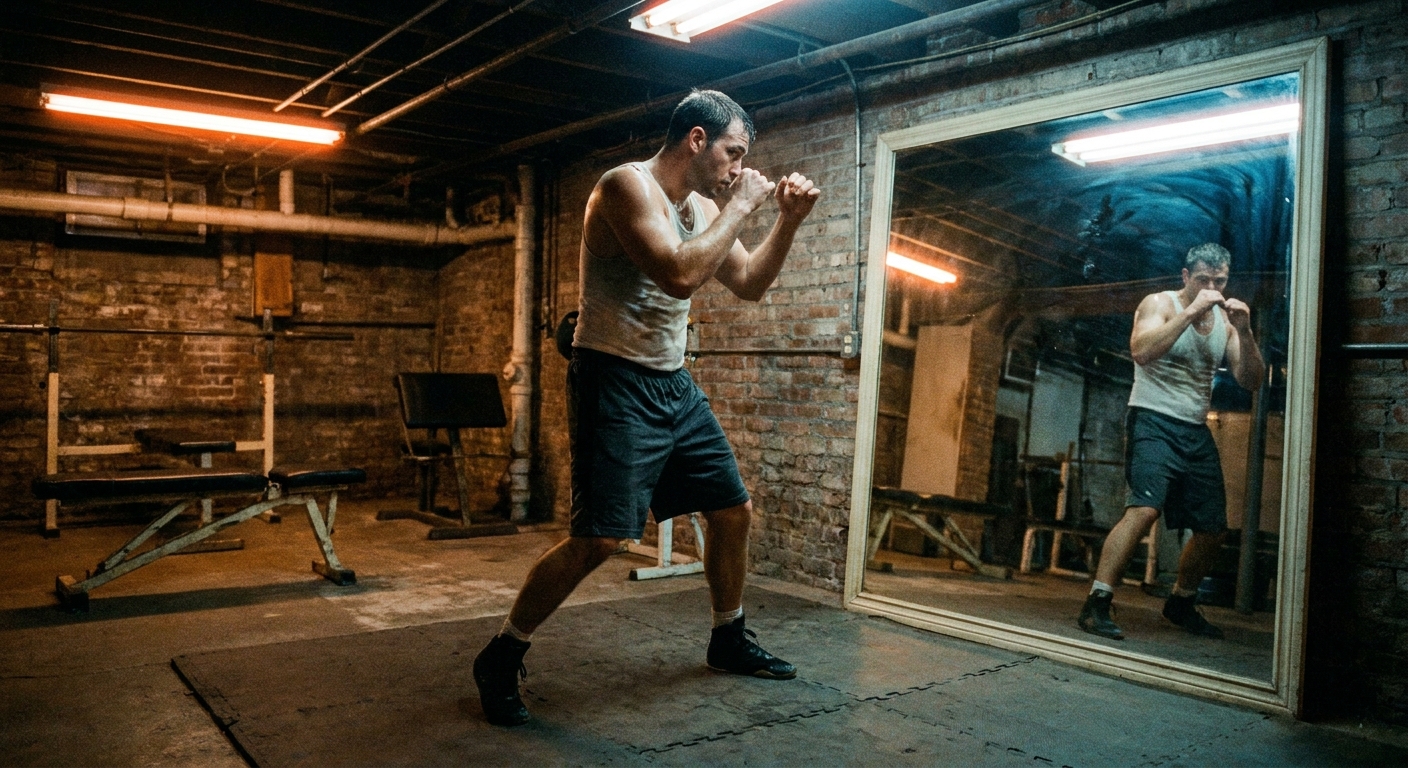
Mirror work on the pivot. Stand facing a mirror, shadowbox one round of pure boxing, then add kicks on a second round. Watch the lead foot. If it’s not pivoting, you’ll see your hip stay locked. The mirror gives you feedback no coach can give you mid-round — you see your own mechanics without anyone having to stop the session to correct you.
What to expect in the first four weeks
Week one: Everything feels wrong. The pivot is awkward, the chamber feels unnatural, and the kick produces a sound like someone dropping a pillow on the bag. Your nervous system is building a new motor pattern on top of an existing one that conflicts with it.
Week two: The pivot starts to click on slow drills but still disappears when you throw at speed. You’ll notice the balance problem most when trying to kick after a jab-cross — the combination ends, you rush to kick, the weight isn’t over the lead leg, and the kick stumbles. Focus on the reset between the punch and the kick: retract, shift weight, then kick.
Week three: The kick starts to feel like a kick rather than a controlled fall. The shin contact is becoming consistent. You’re still dropping the guard on the kick but you’re at least noticing when it happens.
Week four: You can throw a rear roundhouse that lands with actual body rotation behind it. Not powerful. Not automatic. But mechanically sound. This is when the drills for building kick power start making sense — because you have something to build power into. Adding power to broken mechanics just locks in broken mechanics.
The lead kick: a different problem entirely
The lead roundhouse is, for many boxers, harder than the rear kick — not because the mechanics are more complex, but because the lead leg does almost no work in boxing. The jab uses the lead arm and a slight lean; the lead leg mostly just weights the lead side or steps. Asking it to generate a kick from scratch with no warm-up hip rotation is foreign.
The lead roundhouse also exposes you differently. Stepping into a rear-leg kick is moving away from the opponent; stepping into a lead-leg kick means your body is momentarily square-on. Boxers feel naked doing it.
For boxers specifically: train the lead kick separately from the rear kick for at least the first month. The motor patterns are different enough that drilling both simultaneously creates confusion. Isolate the rear kick first, get it functional, then add the lead. The differences between kickboxing and Muay Thai matter here too, since kickboxing lead kicks and Muay Thai lead kicks (teeps vs roundhouses) have their own mechanics worth separating.
Integrating kicks with your boxing without breaking either
The long-term challenge isn’t learning to kick. It’s learning to kick without softening your boxing. Crossover athletes sometimes start rounding off their boxing guard as they get more comfortable with kicks — the stance widens, the hands drop slightly to accommodate the hip rotation, the footwork gets bigger and more committed. Those changes make the kicks feel more fluid while slowly eroding the tight boxing mechanics that were your strength to begin with.
One useful training division: pick specific rounds for boxing-only work and separate rounds for kick integration. Don’t let the two blur constantly during the early months. It keeps both skill sets cleaner and makes it easier to identify when kick habits are leaking into boxing rounds.
The more you understand which boxing skills carry into Muay Thai and which ones create friction, the better you can build a drilling schedule that develops both without one eating the other.
When to start sparring with kicks
Wait longer than you think you should. A kick with unstable mechanics doesn’t just miss — it leaves you in a compromised position that a halfway-competent sparring partner will exploit. Falling out of a kick in shadowboxing is embarrassing. Falling out of a kick in sparring is a takedown or a clean counter shot to the face.
Most Muay Thai coaches recommend at least six to eight weeks of bag work with kicks before adding them to sparring. For boxers specifically, who have the punching instincts to return immediately to combination work but are still building kicking stability, err on the longer end. Throw the kick in sparring when it feels boring on the bag — when the mechanics are automatic enough that you’re no longer thinking about the pivot.
That’s the test. If you have to mentally remind yourself to pivot the base foot, the kick isn’t ready for sparring.
The bag is your best coaching tool here
Kicks on a heavy bag give feedback that shadowboxing can’t replicate. If your hip isn’t rotating through, the kick bounces back without penetrating. If your shin angle is wrong, you feel it in the foot. If you’re not returning to chamber, the bag reveals it — you’ll find yourself standing too close with no exit angle after the kick lands.
Structured bag rounds beat open drilling here, because the bag doesn’t let you pause and reset your mental preparation between kicks the way you can in shadow work. Structure a round timer, commit to including at least two kicks per combination, and let the clock force you to kick when you’re not mentally prepared for it. That’s when your mechanics either hold up or fall apart, and either way you learn something useful.
If you want to track your rounds with interval control and rest periods while building this skill, Heavy Bag Pro is built for exactly this kind of structured bag work — set your round time, rest intervals, and let the timer run so your attention stays on the kicking problem instead of watching the clock.
A research note on motor learning
There’s solid evidence from motor learning research that skills built on conflicting base patterns take longer to consolidate than genuinely novel skills. A study published in the Journal of Motor Behavior found that interference between similar motor sequences was the main driver of consolidation failure in dual-skill training contexts. The implication for boxers learning to kick: you may actually learn to kick faster if you train it as its own isolated block early on, rather than immediately integrating it with boxing work. Once each skill is consolidated individually, the combination work goes faster than if you tried to build them simultaneously from day one.
This matches what coaches tell crossover athletes intuitively: learn one thing cleanly before you mix it with another thing you’re also still learning.