
Punching power is the most overrated number in boxing. Fans argue about who hits hardest, fighters insist they felt nothing, and everybody forgets that a punch is mostly a body moving through space, not an arm swinging.
A recent thread on r/Boxing asked whether fighters lie about their opponents’ power. The top answers were blunt: adrenaline hides pain until the next morning, brain trauma blurs memory, and retired fighters rewrite history. All true. But the thread also shows how much confusion surrounds what “power” even is. So here are the myths worth burying, one at a time, with what the evidence says and what to do about it on the bag.
Do fighters really lie about how hard the other guy hit?
Some do. Some are just wrong without knowing it.
The adrenaline explanation is the honest one. A fighter with a lumped-up face and a cut over the eye can say “I never felt it” and mean it, because the pain arrives hours later in a cold dressing room or the next morning. Liver shots are the classic example: nobody feels the damage while the fight is on, and nobody forgets it the following day.
Then there is legacy. Retired fighters asked to name the hardest puncher they faced often pick the man who beat them, because it makes the loss easier to carry. Others pick nobody, because admitting a rival hurt you hands him a mental edge for a rematch that may never come. Roberto Duran’s version of his loss to Thomas Hearns is a good illustration: in his telling the knockout came because he was drained from making weight, not because Hearns hit like a freight train. Maybe so. Maybe not. Memory after a knockout is not a reliable witness.
The takeaway for you is practical. Never judge a fighter’s power by what he or she says about someone else. Judge it by what happened to the head in the replay.
Is the punch that hurts the one you can see coming?
No. Usually it is the one you did not see.
Fighters say this constantly, and it matches how the knockout sequence works. A flashy shot that lands flush on a fighter who saw it coming can do less than a short, ordinary counter that lands while he is breathing in, off balance or looking the wrong way. When you see the punch you tuck the chin, tense the neck and roll a little. When you do not, the head takes the whole thing.
This is why timing beats raw force in most fights. Bernard Hopkins built a late career on being a step ahead of younger, harder punchers, and Floyd Mayweather won title after title without anyone describing his hands as a weapon. Both let the opponent come forward and made them miss first.
On the bag, that means a hard punch thrown with no setup is worth less training time than a hard punch thrown at the end of a feint, a pivot or a slip. Add the context and the force takes care of itself.
Does punching power come from the arm?
This is the biggest myth, and the only one with real lab data against it.
In 2005 a team at Wayne State University had seven Olympic boxers from five weight classes throw 18 straight punches at the face of a crash-test dummy, with high speed video and force measurement. The study in the British Journal of Sports Medicine reported average punch force of 3427 newtons, a hand speed of about 9 metres per second, and an effective punch mass of 2.9 kilograms. The part that matters: punch force was higher in the heavier weight classes, mostly because their effective mass was higher, not because their hands were faster.
Effective mass is how much of the body is behind the fist at impact. An arm punch moves a hand and a forearm. A punch driven off the floor, through a firm hip and a braced trunk moves a lot more. Same hand speed, much more force. That is the whole secret, and it is why a lightweight with sloppy mechanics can look like he is hitting hard and still not hurt anybody.
If you want to put more of yourself behind the punch, start where the force starts. Hip mobility limits how far you can rotate and load a rear-hand shot, which is why the work in Boxer’s Hip: Mobility for Stronger Punches and Kicks pays off in punching before kicking. A weak back or a soft trunk leaks force just as fast, and Boxer’s Back covers the posterior chain side of it.
Stop curling and start pushing the floor away.
Is knockout power something you are born with?
Partly. Nobody is going to turn a man with slow hands into Earnie Shavers, whose record of knockouts made him the answer to the hardest hitter question for decades. Some people carry more fast-twitch muscle, longer levers or a natural snap that cannot be taught.
But the genetic argument is mostly an excuse. Most gym fighters leave huge amounts of force unused because of three habits: tensing the arm and shoulder before impact, letting the back foot stay flat, and punching with the head already moving backward. Fix those and a fighter who thought he had no power finds some.
Relaxation is the underrated one. A tight arm slows the punch down, and speed counts as much as mass. The hand has to stay loose until the last moment, then close, then release again. Think of a whip: the snap travels from the foot to the knuckle, and the arm just delivers it.
Does hitting the bag hard prove you hit hard?
Not by itself. A heavy bag is a convenient surface, but it tells you less than you think.
A bag swings, absorbs and sometimes just moves out of the way, so how far it travels depends on its weight, how it hangs and how tightly the filling is packed. A bag that rocks wildly can feel like proof of power when it is only a light bag. A dense bag that barely moves can make a hard puncher feel weak. Phone apps that estimate punch force from sound or movement have the same problem: they can compare today’s session with last week’s on the same bag, but they cannot tell you how a punch would land on a person.
Use the bag for what it gives you honestly. It shows whether the punch lands flush, whether your wrist stays straight and whether you stay balanced after throwing. It shows how you feel when you commit to a punch with full body weight, over and over, with a sensible rest in between. Chasing a number on a screen adds nothing.
How do you build more power without hurting your hands?
Use force-output work in short, controlled doses and keep the rest of the session technical.
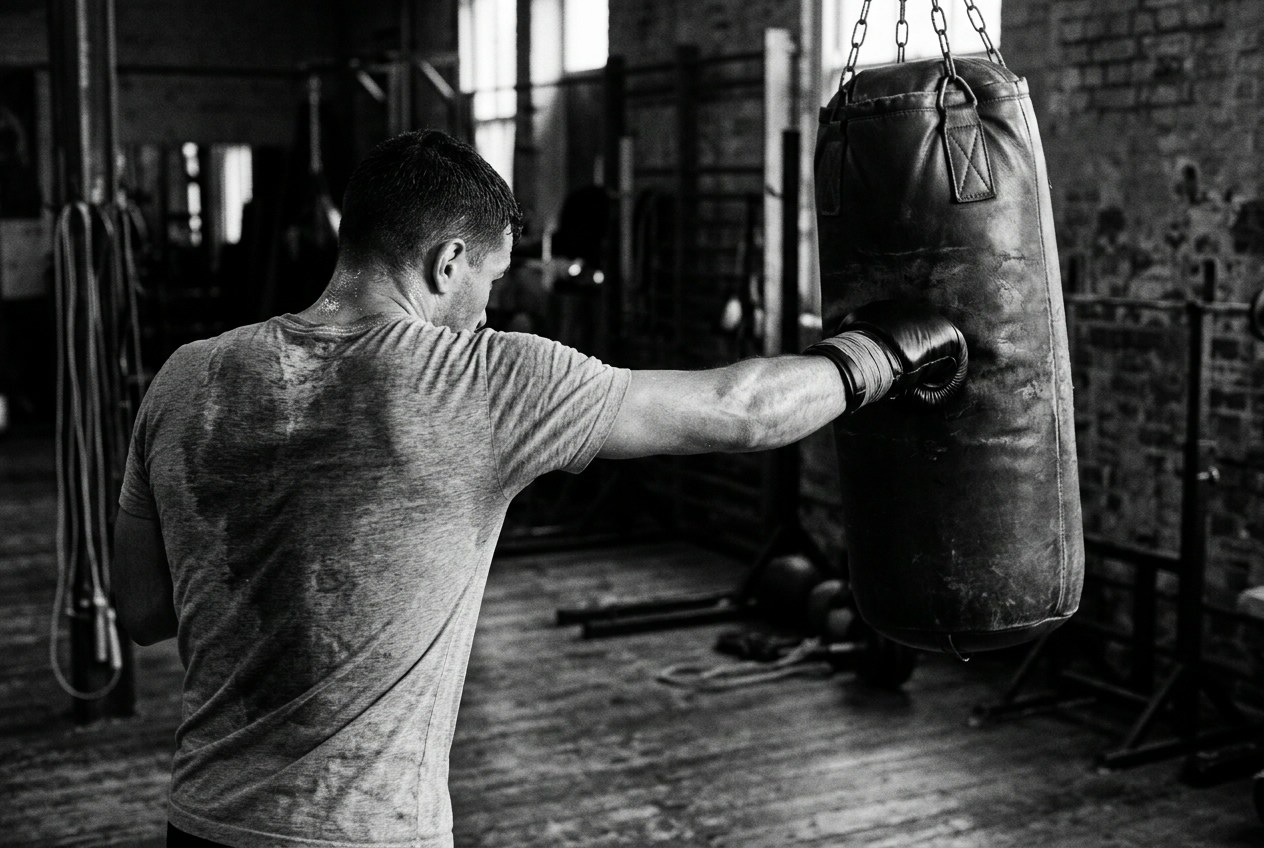
Start with single shots. Throw one hard cross, reset your stance completely, and throw the next. Lazy bag work lets momentum cover the gaps; stop-and-go singles expose how the punch really starts. Watch your back foot: if the heel does not turn and the hip does not close, the punch is an arm punch.
Mix hard singles with relaxed flow inside the same round. For example, let the first half of a round be fast loose combinations and finish the round with a handful of full-commitment punches, resting a beat between each. Setting up a round like that takes a minute inside our free boxing round timer, and the combos with audio callouts keep your hands busy so you do not switch off during the lighter work.
Add a few off-bag drills to teach the body to move as one piece. Rotational medicine ball throws against a wall teach the hip and trunk to fire in order. Jump rope and low-impact plyometrics build the quick, springy legs that drive the punch. Plank variations and anti-rotation work give you the stiff trunk that carries force from the floor to the fist, and if you want a program for that part, the 30-day challenge in Abs Pro covers the core side.
Wrap your hands and wear proper bag gloves. Hard punching on an unprotected hand is how people find out about boxer’s fractures. If a wrist hurts, stop and look at the cause before you hit anything else.
Does weight class change the answer?
Yes, and the study above says so directly: the punch gets more severe as the weight class goes up, mostly because of mass.
That is one reason a heavyweight can look clumsy and still end a night with one punch, while a flyweight with beautiful technique needs a sequence. Smaller fighters win through accumulation, timing and angles. Bigger fighters get a bigger payoff from every clean connection. Neither is better; they are different jobs.
It also means comparing yourself with a friend who is twenty kilos heavier says nothing. Compare your punch with your punch last month. Same bag, same gloves, same wrap, same warmup. If your stance is more stable, your hands are more relaxed and the bag moves in a way it did not before, you are improving.
So what should you believe?
Believe the replay, not the post-fight interview. Believe the lab data over the barroom argument. Believe that power is a chain from the floor to the fist, and the weakest link sets the ceiling.
Fighters do lie about opponents’ power, sometimes out of pride and sometimes through honest loss of memory. That tells you nothing about your own punches. Pick one thing from this list, throw single shots on the bag this week with a clean pivot, and watch what changes.