
The chin gets all the credit, and that’s backwards. A chin is a jaw and a bit of bone. What decides whether a punch snaps your head around or gets absorbed is the column of muscle underneath it, and almost nobody at a commercial boxing class trains that column on purpose. Pros do. Amateurs who spar regularly should too, and you don’t need a fancy machine to start.
What does a strong neck do for a boxer?
Think about what happens when a hook lands. The glove hits the side of the face, the head wants to rotate and whip, and the brain sloshes along behind it. Muscle around the cervical spine can’t stop the impact. It can change how much of the blow turns into fast head movement, and fast head movement is what fighters, coaches and doctors worry about.
There’s a second job that gets less attention. A strong neck lets you keep your chin tucked for a full round without your traps burning out. Watch a tired amateur in the third round of a Golden Gloves bout and you’ll see it: the chin floats up, the eyes lift, and the jaw is suddenly exposed. Some of that is cardio. A lot of it is a neck that has never been asked to hold position under fatigue.
Then there’s the clinch. In Muay Thai the neck is a weapon and a target, and fighters at Lumpinee spend whole sessions in the plum, wrestling for head position. A boxer gets tied up less, but every inside exchange still involves someone leaning on your head. If your neck folds, your posture folds with it.
Who made neck training famous?
Mike Tyson, mostly. The photos of a teenage Tyson in Cus D’Amato’s Catskill gym, with a neck nearly as wide as his head, did more for neck training than any study. Tyson’s routine has been retold so often that the details get exaggerated. The broad strokes are well documented: wrestler’s bridges, neck harness work, and a coach who wanted his fighter very hard to hurt.
D’Amato wasn’t inventing anything. Wrestlers had been bridging for generations, and plenty of old boxing gyms kept a leather harness hanging on a nail next to the speed bag. What changed is that the strength and conditioning world later caught up, and rugby and American football programs started treating neck work as standard. Boxing, oddly, drifted the other way. Plenty of modern gyms have a dozen bags and not one neck harness.
So if the guy in your gym with the thick neck seems like a relic, he’s following the oldest advice in the sport. Copy his habit, not necessarily his bridges.
Does a thicker neck stop knockouts?
Here the honest answer is “maybe, partly, and nobody has proven it in boxing.” The research comes mostly from other contact sports. A 2014 study by Collins and colleagues measured neck strength in several thousand high school athletes across sports like soccer, basketball and lacrosse, and the ones who later got concussed had weaker necks on average. That’s an association, not proof that training the neck prevents anything.
Researchers have taken it seriously enough to design trials around it. The TRAIN study protocol, published through the NIH’s PubMed Central archive, set out to test whether a neck strengthening program lowers concussion rates in student athletes, starting from the observation that neck strength already predicted concussion rate in earlier work. Good science moves like that: notice a pattern, then test whether changing it changes the outcome.
What this means for you is simple. Neck training is cheap, low risk when done sensibly, and plausibly protective. It won’t make you knockout proof. A clean shot you never saw coming will still put you down, because timing and surprise matter more than muscle. If you’ve had a concussion, read our plain English concussion protocol for amateur boxers before you add anything, and get cleared by a doctor first.
Which neck drills should you start with?
Start with your own hands. Seriously. Most people who hurt their neck in training did it by jumping straight to bridges or loading a harness on day one. The set below runs in order of risk, lowest first, and you can stay on the first two for a long time without missing out on much.
Manual isometrics in four directions
Sit or stand tall. Put your palm on your forehead and push your head into your hand while your hand pushes back, so nothing moves. Hold for 10 to 20 seconds. Repeat with your hands clasped behind your head, then with one palm on each side of your head. Start at a gentle effort and build up over a few weeks. Breathe the whole time. If you’re holding your breath, you’re pushing too hard.
Chin tucks against the floor
Lie on your back, knees bent. Tuck your chin as if making a double chin, then lift the back of your head a finger’s width off the floor and hold. Short holds. Lower slowly. This drill trains the deep flexors at the front of the neck, which are the ones that keep your chin down when you’re tired. It looks like nothing. Do a few sets anyway.

Bench neck curls and extensions
Once the isometrics feel easy, lie face up on a flat bench with your head just past the end. Lower your head slowly under control, then curl your chin toward your chest. Flip over, face down, and do the reverse for the back of the neck. Bodyweight only at first. Later you can hold a folded towel or a light plate against your forehead, with your hands guarding it. Move slowly in both directions. Fast reps are where people tweak something.
Neck harness
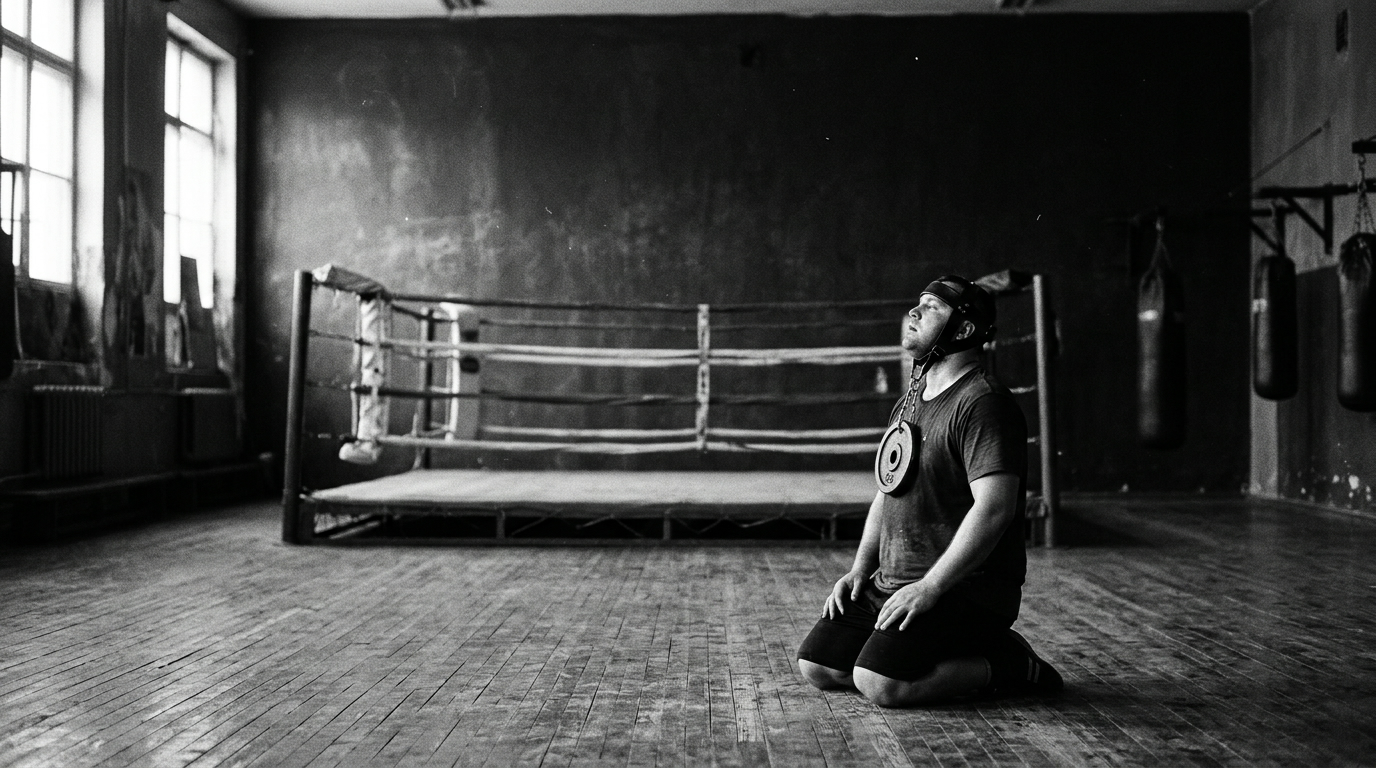
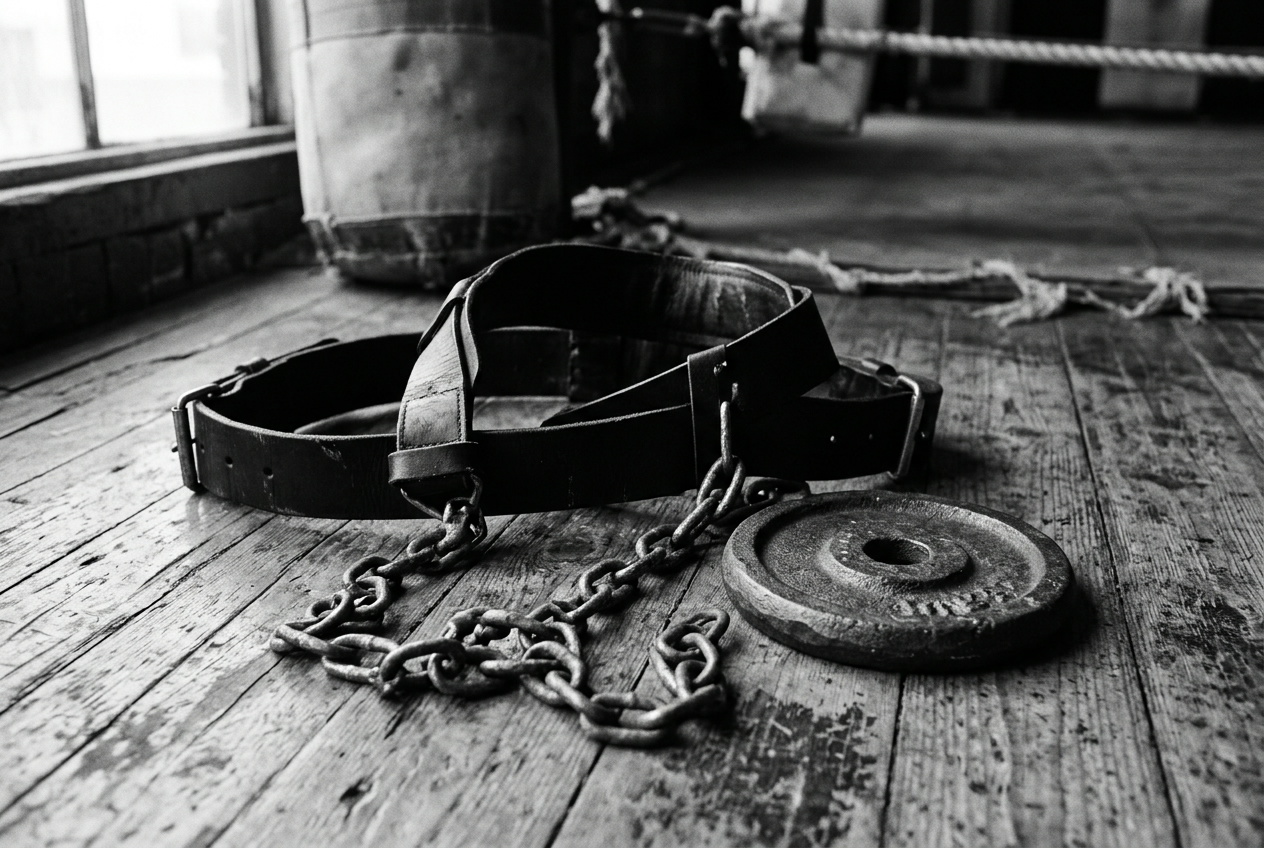
A plain leather or nylon harness with a chain and a light plate is the classic tool, and it’s the one in the old Catskill photos. Kneel or stand with your hands on your knees, let the plate hang, and nod your head up and down through a comfortable range. Pick a weight you could move for 15 to 20 slow reps with good control. Ego has no place on this drill. You’ll see people at your gym swinging a heavy plate with their whole torso; that trains nothing except a trip to the physio.
What about bridges?
Wrestler’s bridges built Tyson’s neck, and they’re a legitimate tool. They also load the cervical spine with a big chunk of your body weight, at end range. If you want to try them, learn them from a wrestling or judo coach who can watch you, start with your hands on the floor taking most of the weight, and skip them entirely if you have any history of neck pain. For most recreational boxers the harness and bench work cover the same ground with less risk.
How often, and how hard?
Two or three short sessions a week is plenty. Neck muscles respond to training like any other muscle, and they need the same recovery. A good template: pick two drills, do two or three sets each, and finish while you still feel fresh. The whole thing takes less time than wrapping your hands.
Progress by adding a little resistance or a few reps, never both in the same week. Stick with manual isometrics and chin tucks for the first few weeks before you touch a harness. Then add the bench work, then the harness. If you feel sharp pain, pins and needles down the arm, or a headache that hangs around after a session, stop and see a physio or doctor. Mild muscle soreness the next day is normal. Nerve symptoms are not.
Older lifters and masters boxers should take the slow lane on purpose. The neck you have at 50 has more wear than the one you had at 20, and the payoff from careful isometrics is still real. Pair neck work with the upper back exercises in our guide to strengthening a boxer’s posterior chain, since a strong upper back gives the neck a stable base to work from.

What mistakes wreck a neck program?
The biggest one is speed. Neck reps done fast and loose turn into whiplash practice, and whiplash is the injury you’re trying to protect against. Every rep should be slow enough that you could stop it at any point.
Second is range. Cranking the head as far back as it goes, with a weight pulling on it, is asking for trouble. Work in a range that feels comfortable and strong. Over time it will open up on its own.
Third, people train only the front or only the back. A lopsided neck is no help when a hook comes from the side. Make sure the side holds from the isometric set stay in your routine, even after you graduate to the harness.
And the sneaky one: doing neck work right before sparring. A fatigued neck is a weaker neck, which is the opposite of what you want when someone is throwing at your head. Train it after bag work or on non sparring days. A Dutch kickboxing gym running hard sparring on Tuesday and Thursday would slot neck work on Monday and Wednesday, and that’s a sensible pattern to steal.
Where does it fit in a bag session?
The easiest place is the cooldown. Finish your rounds, take your gloves off, and spend five minutes on isometrics and chin tucks before you stretch. You’re already warm, the gym is quieter, and it becomes a habit instead of a separate workout you’ll skip. If you train at home, run your bag rounds on the free Heavy Bag Pro boxing round timer, then set it for a few short rounds with rest periods and use those as your neck holds so you’re not counting seconds in your head.
Tomorrow, before or after whatever else you do, try one set of four direction isometrics at half effort. Notice which direction feels weakest. That’s where your program starts.