
What do you do in the ninety seconds after the last bell? If the honest answer is “drop the gloves, grab my phone, sit on the couch,” you are skipping the cheapest part of your training. No gear. No extra fitness. Ten minutes on the floor with your heart rate coming down, and you walk into tomorrow’s session less stiff and with your hands checked.
I’ll be blunt about what a cooldown can and can’t do, because a lot of gym lore oversells it. Then you get the routine itself, minute by minute, built for people who just spent half an hour throwing hooks and turning their hips into a bag.
Step 1: Walk It Down Before You Touch a Stretch (Minutes 0 to 2)
Do not sit down. Your heart is still pounding and your legs are full of blood that needs somewhere to go. Stopping dead and folding into a hamstring stretch is how people end up light-headed, staring at the ceiling and wondering why the room tilted.
Keep moving instead. Walk laps of the room, or shadowbox at a lazy half pace with your hands loose and your feet doing most of the work. Picture the end of a hard Dutch-style kickboxing pad session: the last combination lands, the pads drop, and the smart ones keep their feet moving instead of collapsing onto the mat. Be one of those.
There is decent evidence behind this part. A 2018 review in Sports Medicine by Van Hooren and Peake, which pulled together the cooldown research, found that light active cooldowns bring heart rate down faster and clear blood lactate faster than just stopping. The same review is frank that lactate clears on its own anyway, so don’t treat this as magic. Treat it as a soft landing.
Breathe through your nose if you can. When nose breathing feels easy again, move on.
Step 2: Unwrap Slowly and Check Your Hands (Minutes 2 to 3)
Peel the gloves off. Now unwind the wraps instead of yanking them over your knuckles in one sweaty tube.
This minute is a hand inspection disguised as a chore. Look at the knuckles of your index and middle fingers. Redness is normal after bag work. A split, a puffy knuckle that looks bigger than its neighbour, or pain when you make a slow fist is not normal, and those are the things you catch early or pay for later. Flex your wrists forward and back a few times while the wrap comes off. If one wrist complains on the backward bend every session, your wrapping or your alignment on the bag needs work, and that’s worth knowing before the next hard round.
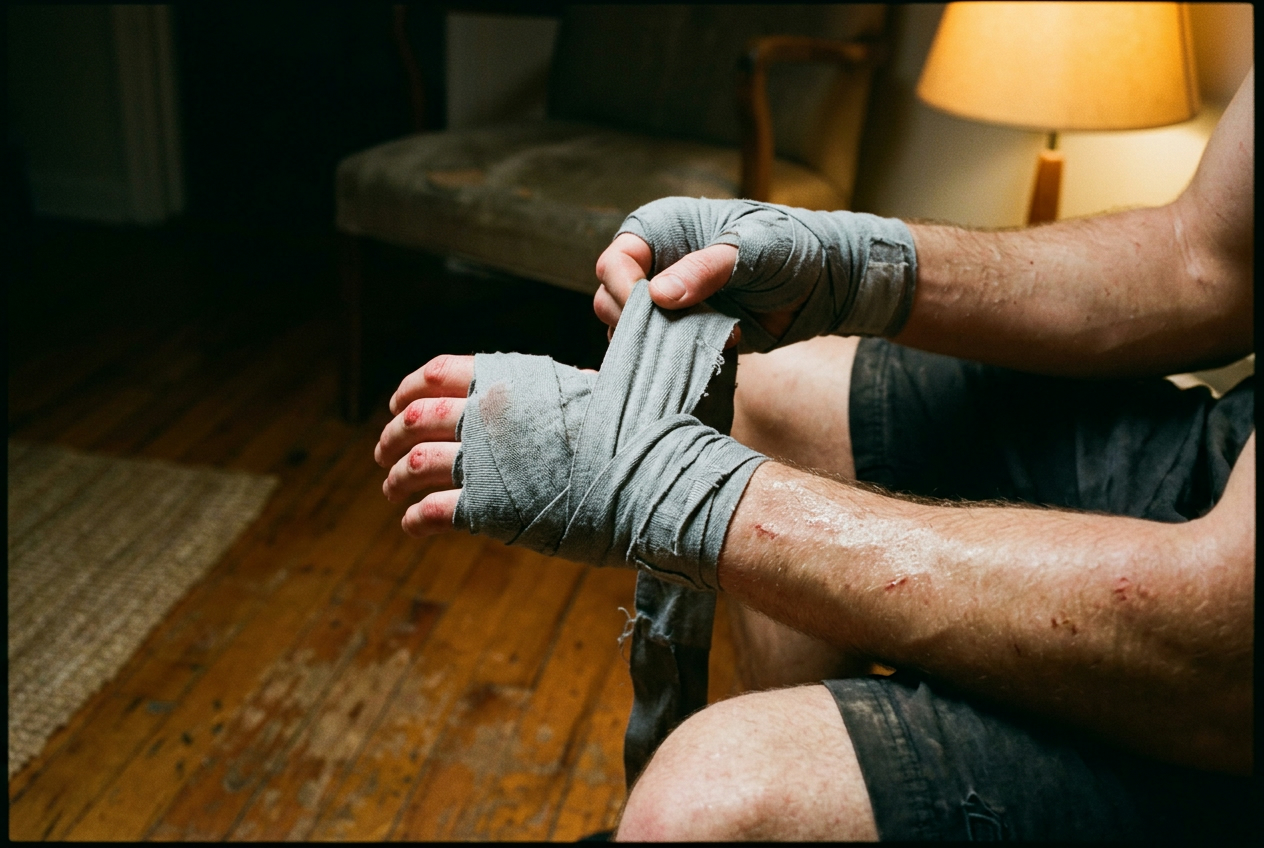
Hang the wraps up to dry. Wraps balled up inside a pair of Cleto Reyes or Winning gloves overnight is how those expensive gloves start to smell like a locker room drain. Open the gloves too.
Step 3: Open the Hips (Minutes 3 to 5)
Every hook, every uppercut, every round kick starts with a hip turn. After a bag session your hip flexors have been firing on every punch, and if you also sit at a desk all day they are already short and cranky before you start. This is where most people should spend the most time.
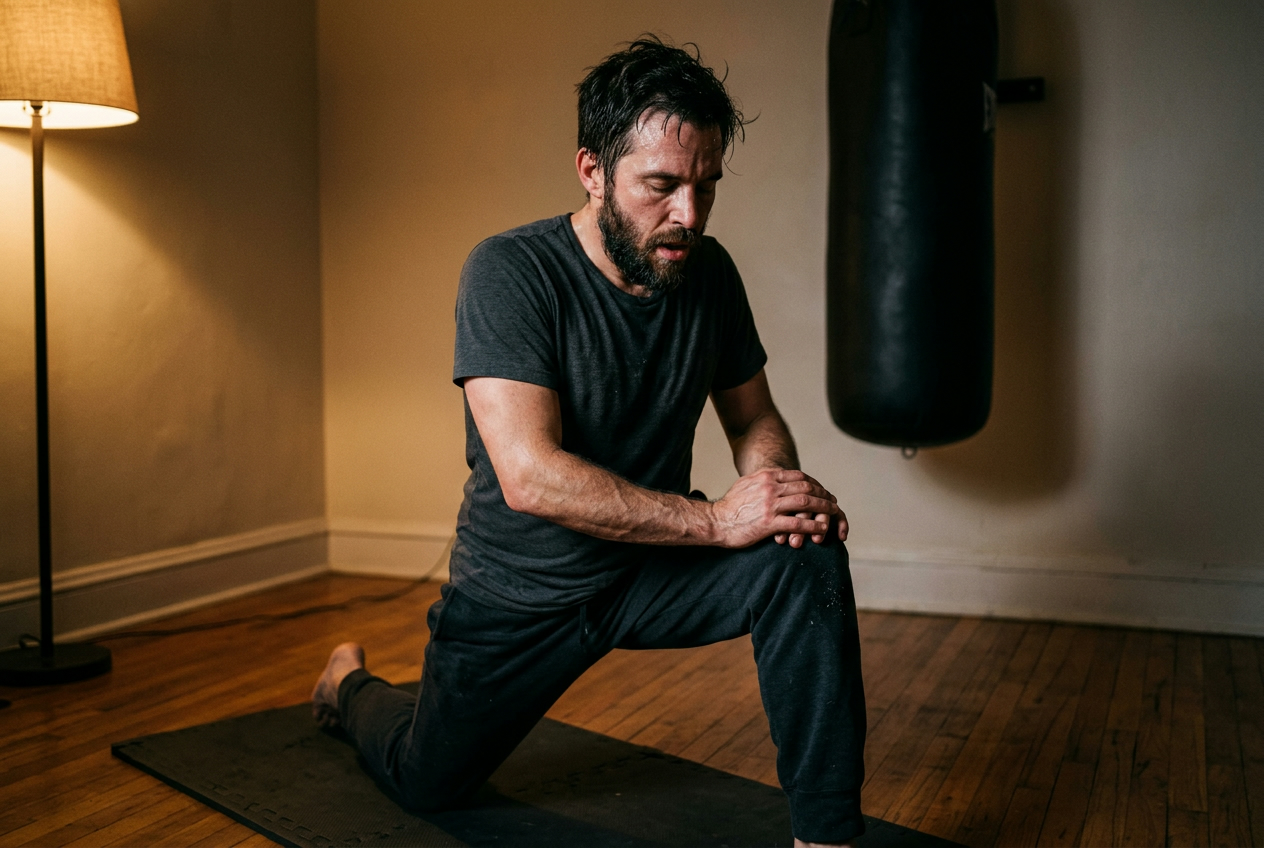
Start with a kneeling hip flexor stretch. Drop your back knee onto the mat, front foot flat, torso tall. Now squeeze the glute on the kneeling side and tuck your pelvis under slightly. You’ll feel the front of the hip open up without leaning forward at all. Leaning forward and arching the lower back is the classic mistake; it feels like a deeper stretch and mostly just loads your spine. Stay for several long exhales, then switch sides.
Then roll onto your back for a figure-four. Cross your right ankle over your left knee, thread your hands behind your left thigh, and pull it gently toward your chest. This one hits the deep glute muscles that rotate your hip when you pivot on a hook. Muay Thai students who come from boxing tend to feel this one most; the kicking leg and the posting leg both get worked hard in a way a boxer’s hips are not used to.
If you only do one thing in this whole routine, do the kneeling hip flexor stretch.
Step 4: Hamstrings and Calves After the Bounce (Minutes 5 to 7)
You spent the whole session on the balls of your feet. Your calves did more work than you noticed. Add a morning of roadwork earlier in the week and they can feel like steel cables by Thursday.
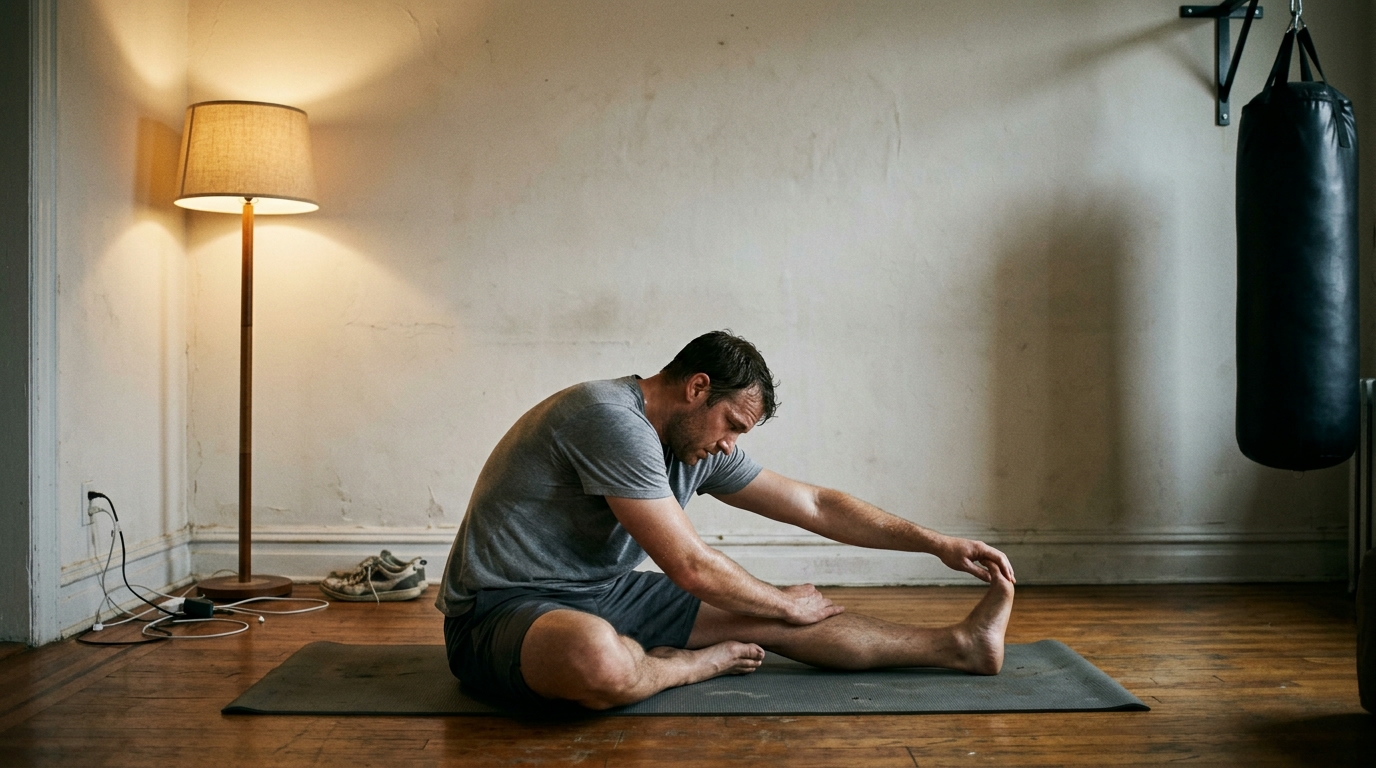
Sit on the mat with one leg straight and the other foot tucked against the inside of that thigh. Hinge from the hips toward the straight leg’s foot, keeping your back long rather than rounding your face toward your knee. Reach as far as is comfortable. A strong pull in the back of the thigh is fine. Sharp pain or a tingling down the leg is not, so back off.
For calves, stand facing a wall with your hands on it, step one foot back, and press the heel into the floor with the back knee straight. Then bend that back knee a little while keeping the heel down. Two different muscles, two slightly different positions, same spot on the floor. Do this straight after your last round of skipping, while the calves are still hot and twitchy.
Do not bounce in any of these. Ease in and wait.
Kickboxers and Muay Thai people get one more stretch here. Stand side-on to a wall, put a hand on it for balance, and let your top leg swing gently forward and back in an easy arc, no kicking, no snapping at the top. Then face the wall and swing the leg side to side across your body. It is movement rather than a hold, which feels strange at the end of a session, but after a night of round kicks into a Fairtex bag the hip joint usually likes being taken through its range under control more than it likes being yanked into one position. Keep the swings small at first. Let them grow on their own as the hip loosens, and stop well before anything pinches in the front of the joint.
Step 5: Undo the Guard Position (Minutes 7 to 9)
A good guard is hands up, elbows in, chin down, shoulders slightly rolled forward. Hold that for six rounds and you finish the session hunched like you’re protecting a sandwich. Your chest and the front of your shoulders are tight, and your upper back is stretched and tired.
Find a doorway. Put your forearm flat against the frame at shoulder height, elbow bent, and step through with the same-side foot until you feel the stretch across your chest. Turn your body slightly away from the arm. Keep your shoulder down away from your ear; if it hikes up, you are stretching nothing useful. Do both sides, then repeat with the elbow a bit higher.
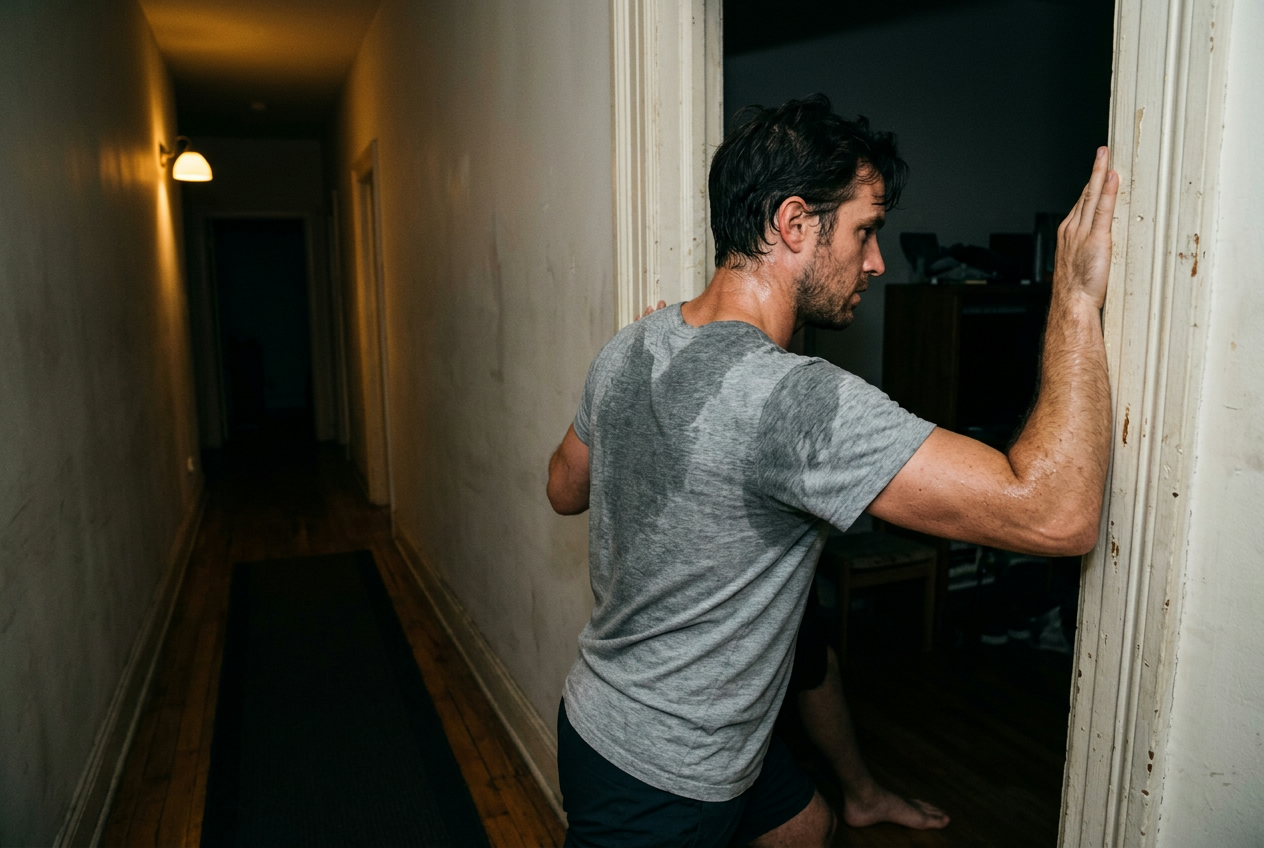
Next, a cross-body shoulder stretch: pull one straight arm across your chest with the other hand, holding it above the elbow, not at the joint. Finish with a lat stretch by grabbing the door frame with both hands at waist height and sitting your hips back until your arms are long and your back rounds a little. You’ll feel it down the side of your ribcage. That’s the muscle that drags your jab back to your face.
If your shoulders give you trouble regularly, this is the place to spend an extra minute, and our recovery and rest day guide covers when soreness means “take tomorrow off” instead of “stretch more.”
Step 6: Lie Down and Let the Breath Slow (Minutes 9 to 10)
Last minute. Lie on your back on the mat, knees bent, feet flat. One hand on your chest, one on your belly.
Breathe in through your nose so the belly hand rises before the chest hand does. Breathe out slowly through your mouth, longer than the inhale. That’s it. Lying still is the step people skip first, because the shower and the phone are right there. Give it the full minute anyway.
The simplest way to stop cutting this short is to put it on a clock. Set our free boxing round timer to short rounds with no rest, and let each bell tell you to switch to the next stretch, the same way it tells you when to stop punching. If you train with Heavy Bag Pro, start the timer the moment your last combo round ends, before you can talk yourself into skipping it.
Step 7: Know What You Just Did (And What You Didn’t)
Here is the unglamorous part. Stretching after training does not prevent next-day soreness. The Van Hooren and Peake review was clear on that, and it also found little evidence that post-workout stretching prevents the slow, wear-and-tear injuries. If you are sore tomorrow, it’s because of what you did in the rounds, not because you skipped the hamstring stretch.
So why bother? Range of motion. Stretch regularly for a few weeks and your hips and shoulders do loosen, and for a fighter that shows up as a deeper pivot on the hook, a round kick that lands higher on the bag and a guard you can hold without hunching. That is the main return, and it builds slowly. The walking minutes earn their place by bringing your heart rate down without the dizzy spell, and the hand check pays off the first time it catches a sore knuckle before a hard bag week turns it into a month off.
Keep the order. Walk first, hands second, hips third, then legs, upper body and breath. Don’t stretch cold muscles before your session as a substitute either; a proper boxing warm-up routine uses movement, not long holds, and the long holds belong here at the end.
Tonight, after your last round, don’t sit on the couch. Walk two laps of the room first.