
“You know what your problem is? You still think you’re a beginner.” My coach said this after I’d been training for almost two years. I didn’t believe him for another six months.

That gap between what you’re capable of and what you think you deserve to call yourself is the definition of imposter syndrome, and boxing breeds it in ways that almost no other hobby does. The belt tests aren’t public. There’s no certificate on the wall. Your progression is invisible to everyone except yourself and a coach who rarely tells you much. So you train for eighteen months and still feel like a fraud lining up next to people who “really belong” there.
I’ve talked to dozens of people who’ve quit boxing in that period. Not because the sport beat them physically. Because they talked themselves out of the room.
A lot of what people believe about imposter syndrome in training is wrong. Not harmlessly wrong, either. Wrong in ways that keep real athletes from progressing. Let’s go through the main ones.
Myth 1: Feeling like a fraud means you actually are one
The people who walk into a gym with total confidence on day one are usually the ones who haven’t yet learned enough to know what they don’t know. Trainers at gyms like Wildcard Boxing in Hollywood will tell you that the fighter who asks the most questions is rarely the worst one in the room.
Genuine imposters don’t worry about being imposters. That’s the actual rule. If you’re sitting with a low hum of anxiety about whether you belong, it usually means you’re comparing yourself to some internal standard, which means you have one. That’s not evidence of fraudulence. It’s evidence of self-awareness.
The neuroscience explanation is reasonably clear: the Dunning-Kruger effect maps this exactly. Competence at a new skill initially tanks your confidence because you gain just enough knowledge to see how much is left. The original Kruger and Dunning study documented this specifically in skill domains, and anyone who’s passed six months of boxing training has lived it.
Feeling like a fraud in boxing usually means you’re in the exact right window of development. Not a comfortable place to be. Still true.
Myth 2: Real boxers don’t go through this
I’ve heard this from four or five people who quit training. Some version of: “The guys who really belong here just train. They don’t overthink it.” Like there’s a category of person who arrived at the gym fully formed, without doubt, and has been collecting skills in tranquil silence ever since.
Ricky Hatton spoke about the anxiety of feeling like an outsider even during his amateur years at Phoenix ABC in Manchester, describing a long stretch where he’d arrive early just to avoid the social part of training. He eventually stopped caring because the training itself became more important than the approval. That took a while.
The trainers who’ve been coaching long enough don’t find imposter syndrome surprising. They find it normal. “Confidence follows competence, not the other way around,” is practically a cliche in boxing corners. The people who look like they belong? They felt exactly the same thing a year or two earlier and just kept showing up.
If you want to track this yourself, there’s a framework worth using. Plateau Breakthroughs maps the progression stages that fighters hit, and knowing which stage you’re in makes the doubt a lot less destabilizing.

Myth 3: The cure is external validation
This is the sneaky one. People look for evidence that they belong: a coach complimenting them, a sparring partner struggling against them, an audience for their training. When the compliment comes, the relief lasts about a day. Then the doubt resets.
External validation has a short half-life because it doesn’t address the actual mechanic. The feeling of not belonging comes from your own internal measurement of your performance. Other people’s approval can’t calibrate that because it’s not measuring the same thing you are. You’re worried you’ve memorized bad habits. Your training partner said nice things about your jab. These are two different conversations.
What does work: objective records. Times, round counts, specific drills you can measure. I started keeping a rough log of which combinations I was working and what felt off at the end of each session. Not for motivation, just accuracy. It’s very hard to believe you’re stagnating when you can see on paper that three months ago you couldn’t chain a jab-cross-hook without losing your guard and now you can.
Using a consistent round timer like the one at heavybag.pro helps with this because it removes the temptation to cut sessions short when confidence is low. Three rounds is three rounds regardless of how bad you feel you’re doing.
Myth 4: Once you’ve been training a while, the feeling goes away for good
It doesn’t. It changes shape.
In the early months, imposter syndrome is about belonging at all. After a year or two, it shifts: now you belong but you’re worried you’re not working hard enough. After sparring starts, it becomes about whether you can fight or just look like someone who can. When you move gyms, it resets almost completely.
Every time you enter a new context in boxing, you’re the new person again. Moved to a different gym. Started competing. Began coaching others for the first time. The sport has a useful habit of putting you back at the beginning of something just when you’d gotten comfortable.
This is probably a feature, not a bug. The anxiety of not knowing how you compare to a new group is part of what keeps people sharp. Floyd Mayweather famously sought out harder training camps when he was already pound-for-pound number one, specifically because comfort in training was a warning sign to him rather than something to protect.
The version that never fully goes away isn’t the problem. The version that keeps you out of the gym for weeks because you’ve decided you don’t belong yet is the problem. The mental mechanics of facing fear in training apply here too: avoidance makes the feeling grow, exposure shrinks it.
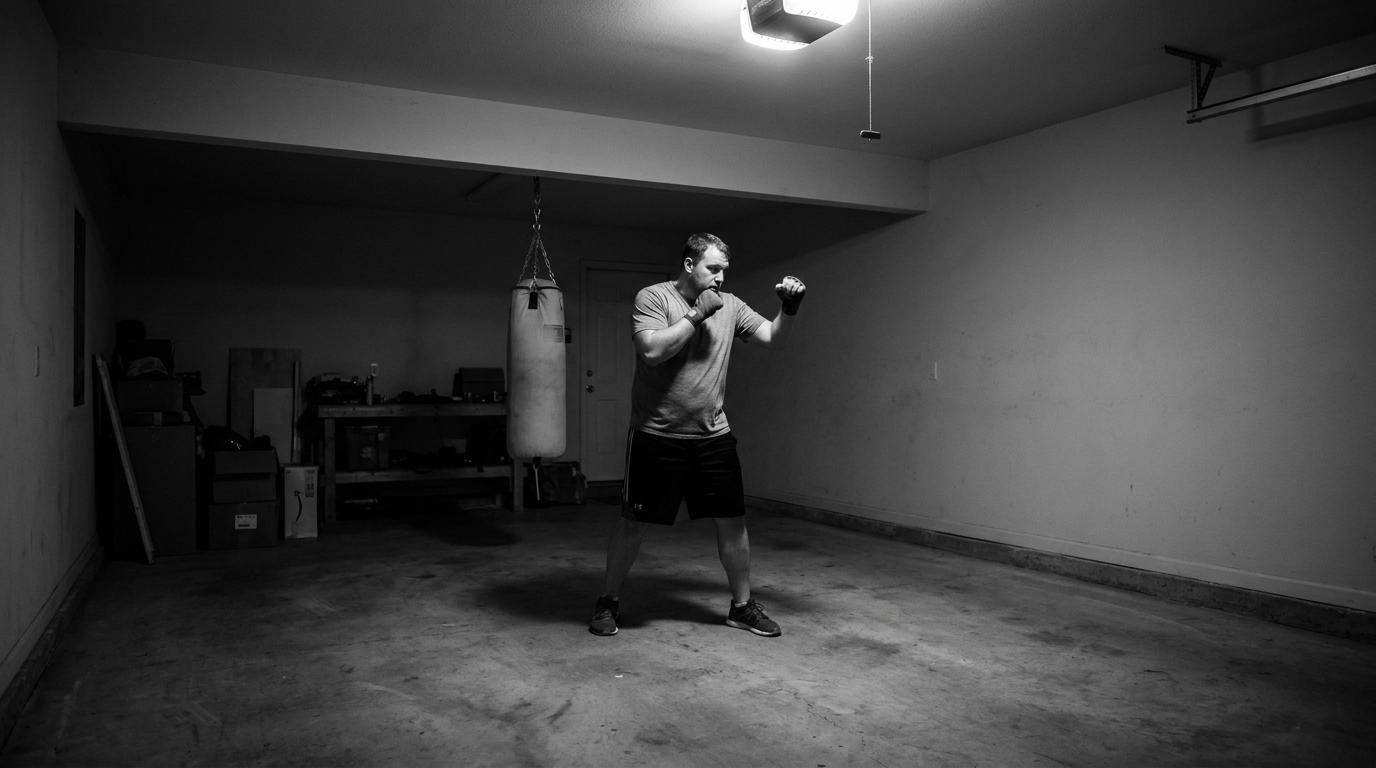
Myth 5: Keeping quiet about it is the smart move
I did this for longer than made sense. Trained with the assumption that everyone else was confident and I was the only one sitting with an internal monologue that said “you don’t know what you’re doing.” Said nothing to anyone.
It took a conversation with someone who’d been training for four years to find out he still felt it. Then someone with seven years said the same. The gym culture around this topic is silent enough that everyone assumes they’re the outlier, which means nobody finds out they’re in the majority.
Talking about it does two things. First, it identifies training partners who understand the actual stakes of a session, which makes the emotional texture of training less isolating. Second, it’s the only way to get actual calibration feedback instead of generic encouragement. “You’re doing fine” is useless. “Your right cross is landing but you’re dropping your left shoulder coming off it” is information.
If you’re not getting specific technical feedback because you haven’t told anyone what you’re anxious about, that’s a solvable problem. The framework for managing pre-training anxiety covers the conversation mechanics in more depth, including how to ask a coach for specific feedback without it turning into a therapy session.
Myth 6: Imposter syndrome means you need to train more
Sometimes. Sometimes not at all. The relationship between volume and confidence is not straightforward.
Training more when you feel like a fraud can be productive if the fraud feeling is coming from specific skill gaps you can identify. You feel like you don’t belong because your footwork is genuinely bad. More footwork drills. Direct relationship.
But a lot of imposter syndrome in boxing isn’t about identifiable skill gaps. It’s about an abstract sense that you’re less legitimate than other people in the room, and that feeling does not respond to extra rounds. It responds to shifting your frame of reference: comparing yourself to your own previous performance rather than to an idealized version of everyone around you.
Three concrete things that work better than just adding sessions:
- Record a short video of yourself shadowboxing quarterly and compare. The progression is usually more visible than you’d expect.
- Pick one technique you were completely confused by six months ago and notice that you’re not confused by it anymore. That’s growth even if it doesn’t feel like enough.
- Ask your coach to name one thing you do better than you did three months ago. Not for encouragement. For calibration. A good coach answers specifically.
The boxing community has covered this under various headings. The r/amateur_boxing forum has several long threads on this exact cluster, and the consistent observation from people who worked through it is that the shift happened not when they got better but when they stopped using the gym to measure themselves against other people.
What actually helps
Short version: show up consistently, track objective progress, find one training partner who’ll give you honest feedback, and accept that the doubt is part of the architecture of learning, not a signal that you’re in the wrong building.
The gyms that create the worst imposter syndrome, in my experience, are the ones where nobody talks, the hierarchy is obvious, and newer people are left to figure out whether they’re improving. The ones that feel healthy are places where a fourth-year fighter will occasionally ask a second-year fighter to show them that combination again because they liked the timing of it. Status is not so rigidly guarded that learning flows one direction only.
If your gym doesn’t feel like that, you can still create some version of it. Find one person a level or two above you who seems to have some patience. Tell them specifically what you’re working on. Ask specific questions. The culture of a gym is not fixed, and newer people change it more than they realize.
And get your training structured well enough that sessions feel like progress rather than auditions. Structured rounds with defined focus, a timer you’re not cutting short, and a clear sense of what you’re working on in each session take a lot of the ambient anxiety out of the room. The Heavy Bag Pro app builds that structure automatically so your training has a shape independent of how you happen to feel that day.
The fraud feeling is not evidence of fraud. It’s just what learning something hard feels like from the inside.