
You’ve done the research. You know you want a heavy bag at home. The question that’s been sitting in your browser tabs for a week is this one: do you hang it from the ceiling, or do you get a free-standing unit and call it done?
Both options work. Neither is right for everyone. The answer depends on factors most buying guides skip over completely, things like ceiling joist spacing in a pre-war apartment, how much you weigh, how hard you hit, and whether your landlord has seen your rental agreement lately. This article goes through it properly, not to sell you on either type, but to give you the information that resolves the question for your specific situation.
The weight that changes everything
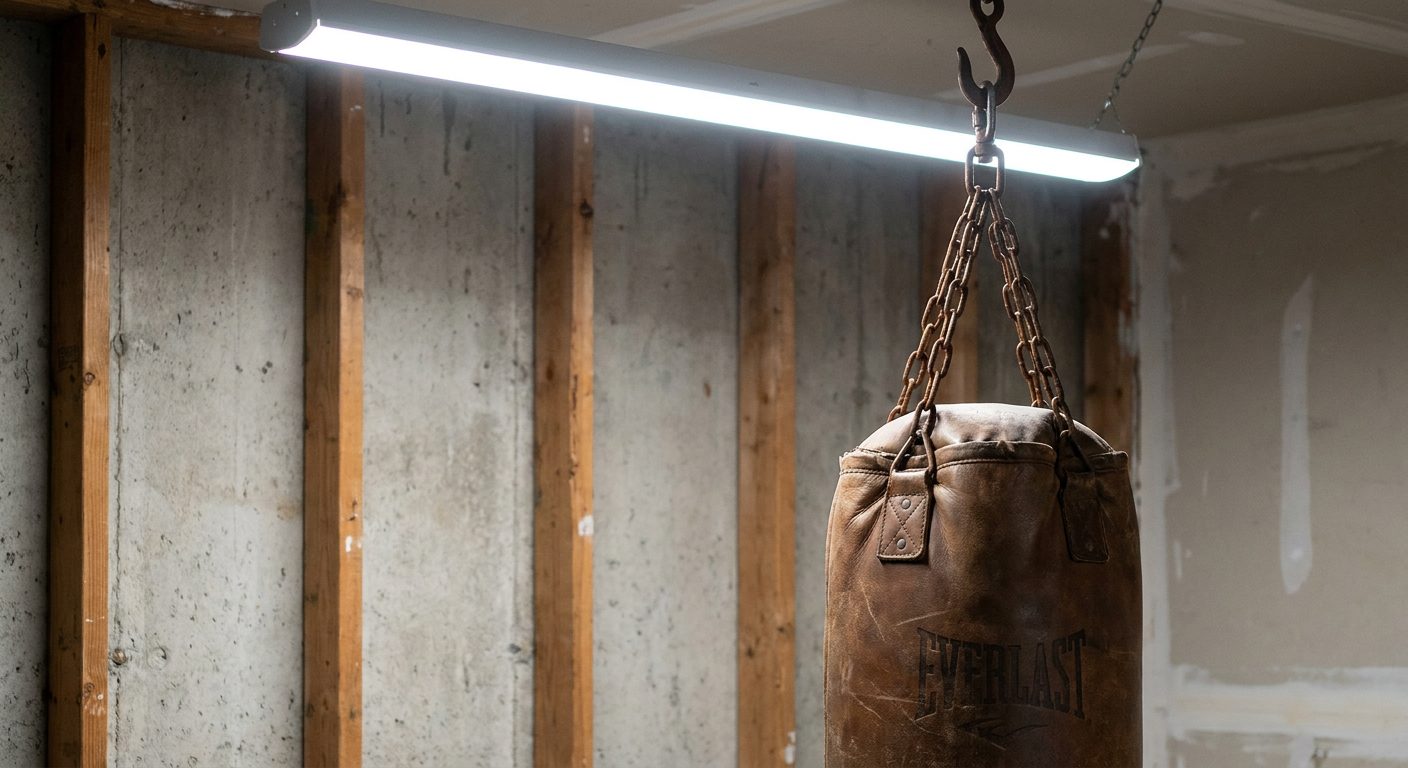
A hanging bag filled with sand and leather will behave differently under hard shots than a free-standing unit resting on a water-filled base. That much is obvious. What’s less obvious is that the difference matters most at the extremes: very light hitters and very heavy hitters both get a distorted picture from vague reviews.
For someone throwing 40-pound effective force per punch (a recreational beginner hitting at low output), a quality free-stander like the Century Wavemaster or the Everlast PowerCore handles rounds without much drama. The base stays put, the bag returns to center reasonably fast, and nothing tips over. Ask the same person to run a 50-punch combination on that base and watch it walk across the room.
For a heavier person with genuine punching output, or anyone who kicks with Muay Thai-style hip rotation, free-standing bags tend to fail on a mechanical level. The base needs enough water or sand to stay put under lateral force, and most consumer-grade bases max out at a point where strong kicks send the whole unit sideways. A hard Thai-style kick to the mid-section of a Wavemaster doesn’t get absorbed the same way it does on a 100-pound hanging leather bag chained to a structural beam.
Hanging bags don’t tip. They swing. Swinging is a training feature, not a problem, because it teaches you to read bag return and time your shots. This is one reason trainers at gyms like Gleason’s Boxing in New York and the Wild Card Boxing Club in Hollywood run almost exclusively hanging bags even in cramped spaces where a free-stander would technically fit. The feedback loop is better.
Where you’re training, realistically
Walk into your intended training space right now. Look up. What do you see?
If you’re in a house with a wood-framed ceiling and accessible joists, hanging is a viable option. The typical suburban garage has 2×6 or 2×8 joists on 16-inch centers, which can handle a properly mounted bag bracket loaded with a standard 70-pound heavy bag. You’re not hanging a chandelier from drywall; you need to locate and hit the actual structural member. Miss the joist and you get a hole in your ceiling and a bag on the floor.
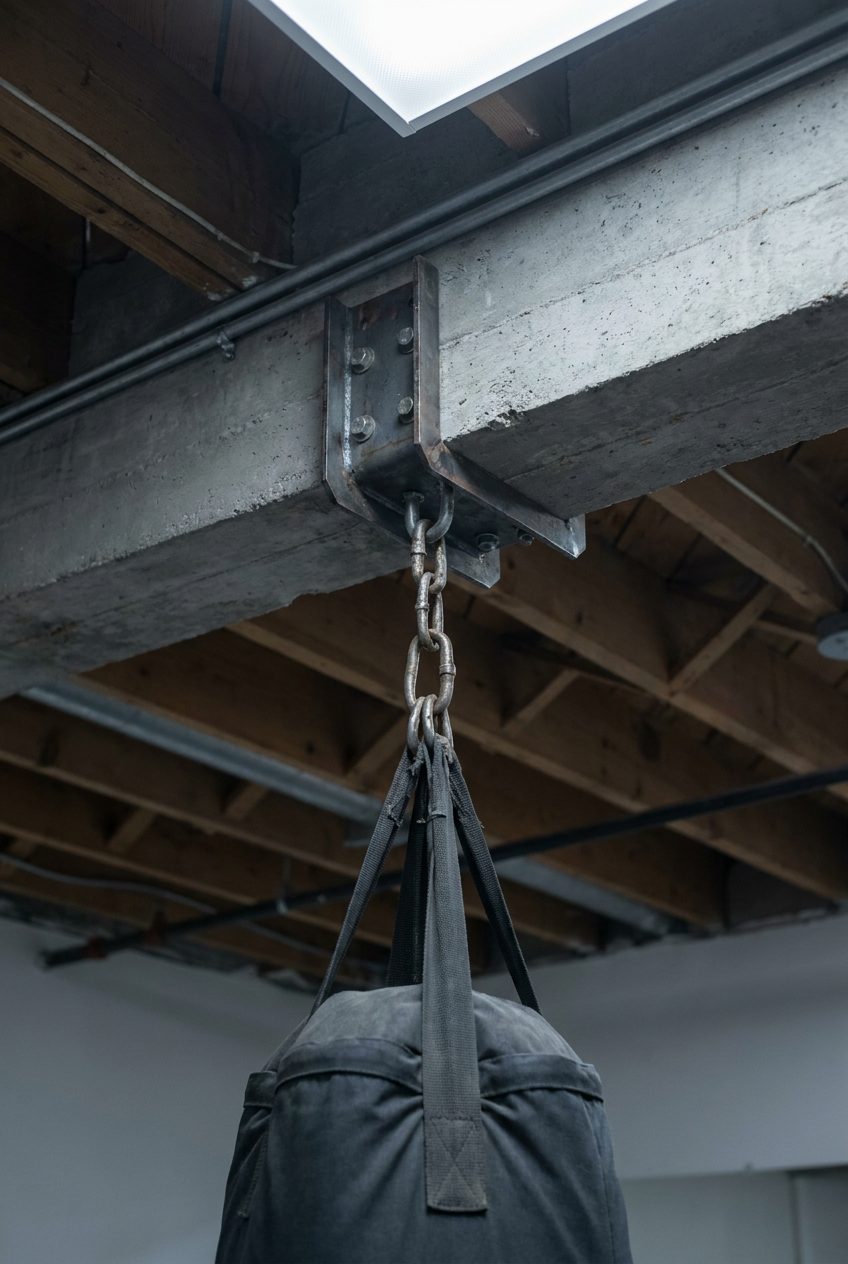
Apartments are a different conversation. Concrete slab ceilings, which are common in anything built after the 1970s in most cities, require anchor bolts and a hammer drill with a masonry bit. That’s doable if you own the place. If you rent, you’re almost certainly violating your lease by drilling into concrete, and the ceiling anchor for a heavy bag is not the kind of hole you patch with spackle before moving out.
The ceiling height also changes the math. You need roughly eight feet of clearance to hang a standard 4-foot heavy bag without it dragging on the floor, with the chain and swivel adding another 18 to 24 inches above the bag. Seven-foot residential ceilings in older homes are borderline. An 8.5-foot garage ceiling is fine. A basement with a six-and-a-half-foot drop ceiling is not.
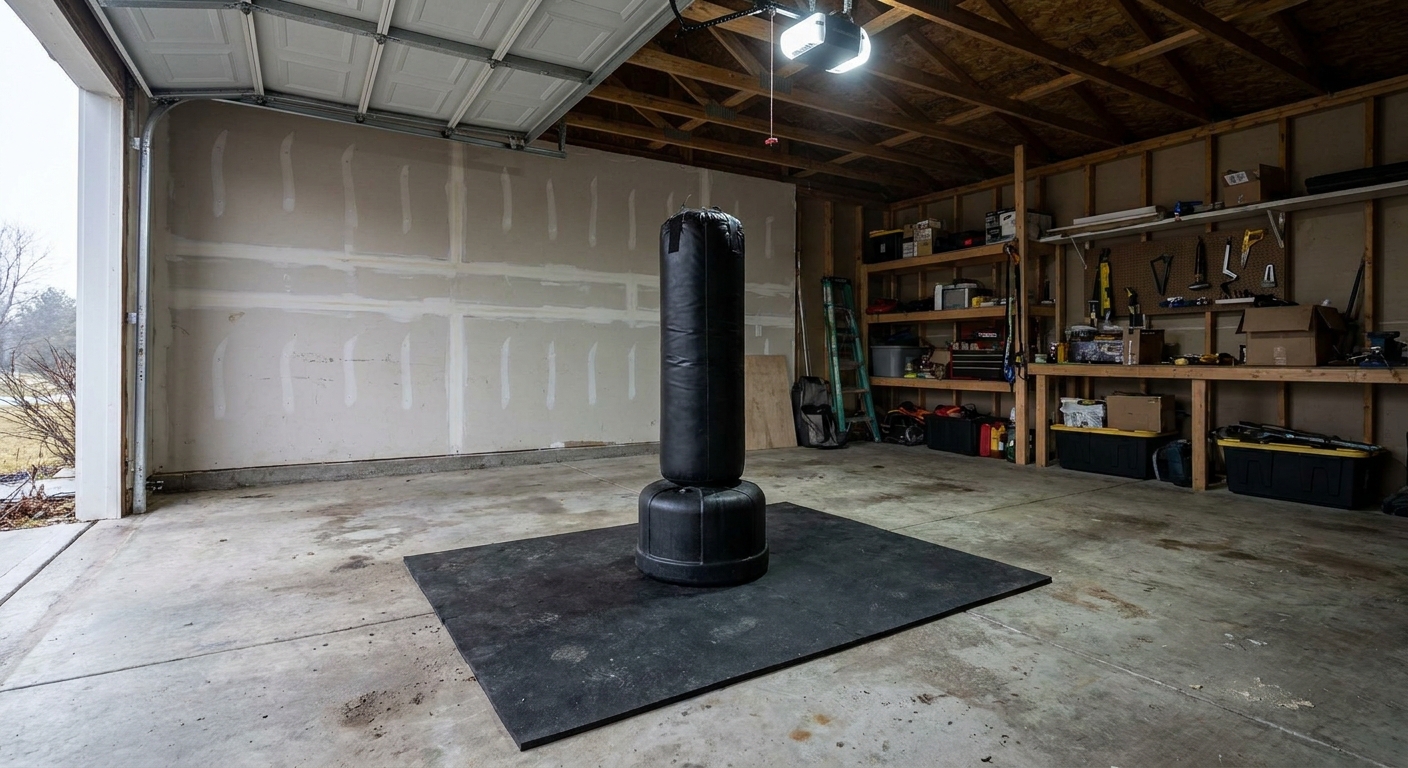
Free-standers sidestep all of this. You wheel them out, fill the base with water or sand, and hit. You can train in a condo, a studio apartment, or a covered parking spot. No drilling, no landlord phone calls, no structural engineering questions. For a meaningful share of home trainers, the free-stander isn’t second-best. It’s the only realistic option.
What the price gap really gets you
Entry-level free-standers start around $80 to $120 for the smallest Wavemaster variants and cap out around $400 to $600 for the larger units like the Everlast MMA-style heavy hitter bag or the Ringside Apex. Hanging bags in a comparable weight range (70 to 100 pounds) run from $80 to $300 for the bag itself, but you also need a mount ($25 to $150 depending on whether it’s a ceiling bracket or a wall mount), chains or straps, a swivel, and potentially professional installation if you’re not comfortable with ceiling anchors.
All-in, a decent hanging setup usually lands in the $200 to $500 range for a home gym installation. That’s similar to a mid-range free-stander. The difference is in what you’re getting at each price point.
A $250 hanging bag from Fairtex, Cleto Reyes, or Everlast is a purpose-built striking surface. The leather or synthetic leather holds shape under repeated impact. The fill distribution doesn’t shift to the bottom after a few months of hard use the way cheap free-stander bags tend to. The swing arc gives you realistic feedback on your punch timing. At $250 you’re getting something built to be hit hard, repeatedly, by someone who intends to improve.
A $250 free-stander at the same price point is a compromised product for anyone past beginner level. The base is narrow, the pole is too flexible, and the target height tends to cap out in a way that makes body punching awkward for taller users. The exception is the higher-end units like the Ringside Fitness free-standing bag or the Title Boxing Club model, which are substantially better but land in the $350 to $500 range. At that price, the gap between free-standing and hanging narrows considerably for recreational users.
For boxing specifically vs for Muay Thai
The use case splits cleanly here. Boxers training on a home bag mostly need a surface that handles punches. The demands on the mounting system are lower because punches land on a narrower horizontal band and the directional force is mostly forward. A free-stander rated for 200-pound users handles boxing combinations without constant drift for most people under that weight.
Add Muay Thai and the requirements shift. Kicks, especially low kicks and body kicks thrown with proper hip rotation and full extension, generate lateral force that free-standing bases resist poorly. The torque on the pole during a hard roundhouse is different from the torque during a cross. Coaches at gyms running Muay Thai programs universally use hanging bags. You’ll rarely see a Muay Thai class built around free-standers because the feedback and the movement pattern are wrong. A heavy bag should swing on impact and return; it teaches timing. A post mounted in a base that rocks slightly teaches you to hit a wobbling surface, which is not what you’re training for.
If your plan is boxing cardio and basic combination work, a quality free-stander covers you. If you’re serious about Muay Thai, or you plan to kick regularly, save for the hanging setup even if it takes longer. The heavy bag training guide on this site covers how to structure rounds productively once you’ve got the bag sorted.
The noise problem, which nobody talks about honestly
Hanging bags are loud. Not loud in a way that bothers you in a detached garage, but loud in a way that bothers your downstairs neighbor at 7 PM on a Tuesday. A 100-pound bag swinging on a ceiling mount in a wood-framed house transmits impact noise through the joists in a way that a free-stander sitting on a rubber mat mostly doesn’t. This is a real factor for apartment dwellers and semi-detached homes with shared walls or floors.
Free-standers, particularly when placed on thick rubber gym flooring, are quieter in terms of structural impact transmission. The noise is contained more locally. You still hear the hits in the room, but the sound is less likely to travel two floors down and make your training hours into a neighbor dispute.
The punch impact noise on a hanging bag is also different from a free-stander. A well-filled leather bag makes a satisfying thud that is genuinely loud in a small space. If your garage connects directly to a bedroom wall, evening sessions become a quality-of-life question for whoever lives in that room. This isn’t a reason not to buy a hanging bag. It’s a reason to think about where you put it and when you train.
The long game: durability and maintenance
A quality hanging bag lasts a long time. A 70-pound Everlast heavy bag with a vinyl shell, used hard four to five days a week for a year, will show wear on the outer surface and may develop some unevenness in the fill. The chains and swivel take more abuse than people expect. Cheap swivels seize up or snap. A $15 ball-bearing swivel replacement is the most common maintenance task for a home hanging setup, and it’s a five-minute job. The way you wrap and punch also affects the wear on your hands and wrists over time; if you’ve already started noticing soreness, the breakdown of long-term wrist pain causes and fixes is worth reading before you commit to a heavy bag routine.
Free-standing bags have a different failure mode. The base develops micro-cracks over time from impact vibration, particularly when filled with water. Sand-filled bases last longer but are heavier and harder to move. The pole-to-base connection point is the most common failure point on lower-end units. Once that joint loosens, the whole unit becomes unsafe to hit hard. Replacement parts are available from most manufacturers for the popular models, but the repair process isn’t always intuitive.
If you plan to hit the bag consistently for years, a hanging setup with a quality bag and a steel swivel is likely to outlast a mid-range free-stander. The total cost of ownership calculation favors hanging if you’re comparing a $250 hanging bag to a $250 free-stander over five years of hard use.
One more thing before you buy
Timing your rounds properly matters regardless of which bag you choose. Unstructured bag work, where you hit until you’re tired and stop, doesn’t build the same conditioning as timed rounds with defined rest periods. Using a structured round timer changes how you train against the bag entirely. The free boxing round timer at heavybag.pro handles this without any app download or subscription. Set your round length, rest time, and number of rounds, and let it run while you focus on the bag work.
The verdict, by situation
One thing worth noting if you’re new to this: proper technique matters more than bag type for injury prevention. Research on boxing-related training injuries consistently points to poor form and inadequate hand protection as the primary causes, not equipment choice. Whatever bag you buy, wrap your hands properly and learn the fundamentals before going full power.
Choose a hanging bag if:
- You own your space or have landlord permission to drill
- Your ceiling has accessible structural joists or concrete anchors are viable
- You train Muay Thai or kick regularly
- You want the most realistic bag feel and return behavior
- You’re willing to spend the time on proper installation
- Noise transmission isn’t a critical concern
Choose a free-stander if:
- You rent and cannot drill into ceiling structure
- Your ceiling height is under 8 feet
- You move frequently and need the bag to be portable
- Your training is primarily boxing-focused without heavy kicking
- You want to start training this week without an installation project
- Noise transmission to neighbors or family is a priority concern
The free-stander you set up and use beats the hanging bag you keep meaning to install. That said, if your situation allows for hanging, hang it. The training feedback is better, the durability is better, and a good hanging bag with a quality swivel is one of the more satisfying pieces of kit you can add to a home training space.
For the full setup walkthrough once you’ve made your choice, the cost analysis comparing home training to gym membership might help put the investment in perspective before you commit.