
Most people who give up on heavy bag training give up because their wrists hurt. Not their shoulders, not their conditioning, not motivation. Wrists.
Hand wraps solve that problem for about eight dollars, which makes them the best value item in boxing by a considerable margin. What almost nobody gets taught is how to use them properly, so people end up wrapping their knuckles beautifully and leaving the joint that takes the real punishment almost completely unsupported.
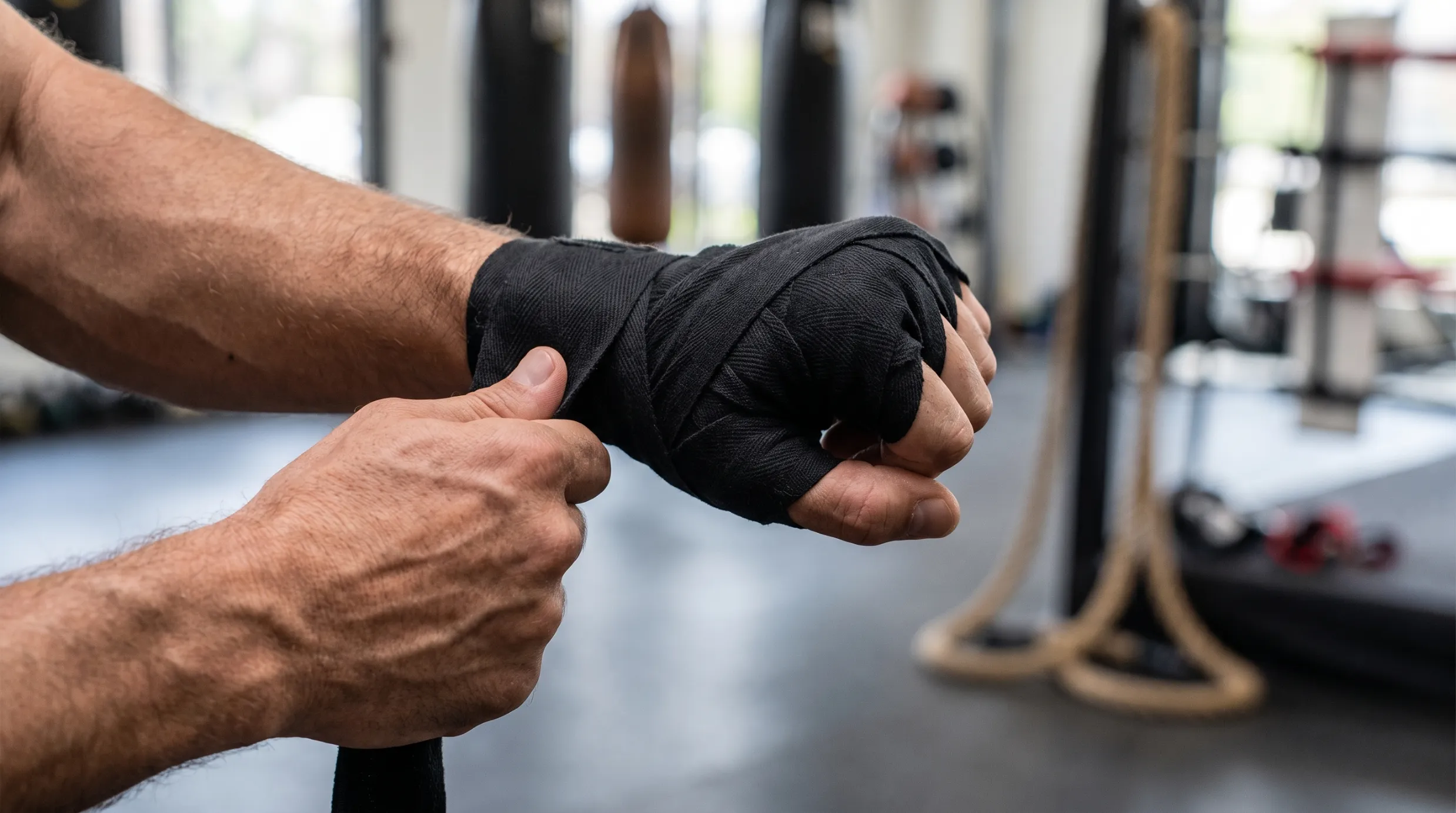
What a hand wrap is actually doing
There are 27 bones in the human hand, most of them small, held together by soft tissue that evolution did not design to be driven repeatedly into a 70 lb bag.
Wrapping does three separate jobs. It binds those small bones together so the hand behaves as a single unit rather than as a collection of parts that can shift against each other on impact. It braces the wrist so the joint cannot fold backward when the punch lands slightly off. And it adds a thin layer of padding across the knuckles, which is the least important of the three despite being the one people think about first.
Wrist bracing is the job that matters. Bruised knuckles heal inside a week and you will barely remember them. Wrist damage from months of punching with a joint that keeps collapsing is the kind of injury that follows people around for years, flares up under load, and quietly ends a lot of home training.
Choosing a length
| Length | Suits |
|---|---|
| 108 to 120 inch | Children, teenagers, small adult hands |
| 180 inch | Most adults, and the safe default if you are guessing |
| 200 inch and up | Large hands, or anyone who wants extra wrist support |
Cotton with a small percentage of elastic woven through is the standard construction and what most people should buy. Fully elastic wraps go on faster and forgive sloppy technique, at the cost of holding the hand less firmly. Pure cotton wraps hold their shape completely and stay exactly as tight as you made them, which is excellent once your technique is consistent and unforgiving while you are learning.
How to wrap your hands, step by step
Keep the hand open and the fingers slightly spread throughout. Pull each turn firm, never tight enough that you feel your pulse or watch the color drain out of your fingertips. Expect two minutes a hand for the first week, and thirty to forty seconds once the sequence lives in your hands rather than your head.

Anchor the thumb loop with the wrap facing down across the back of the hand, then let that first turn settle before you carry on.
Take three turns around the wrist, straight around the joint, each one flat and overlapping the turn before it by roughly half. Rushing this is the single most common mistake in the whole sequence, and it is the one that costs people their wrists.
Carry the wrap up to the knuckles, diagonally across the back of the hand, and take three turns around them. Keep the fabric flat and spread rather than letting it bunch into a rope.
Come back down for one turn at the wrist, which locks in everything so far and gives you a base for the section that matters most.
Work between the fingers, coming up through the gap between the little finger and the ring finger, over the back of the hand, and down to the wrist. Repeat between ring and middle, then between middle and index, returning to the wrist after each pass. These three passes are what genuinely bind the knuckles together, and skipping them is why a lot of wraps look right and protect nothing.
Lock the thumb with one turn around its base and a return to the wrist. That stops the thumb rolling outward when a punch lands slightly off center.
Spend what is left across the knuckles and the wrist, alternating between the two. Finish at the wrist so the velcro closes flat against the joint rather than over a knuckle.
Now make a fist, which should feel supported and slightly compressed when closed and a little loose again when the hand opens. If it feels tight with the hand open, unwrap it and start over, because it will only get tighter once you close it.
Making the wrap fit inside your glove
Wrap length and glove size need deciding together, and hardly anyone does that until a glove refuses to close.
Sixteen ounce training gloves swallow a 180 inch wrap without complaint. Ten and twelve ounce bag gloves are cut much tighter through the palm, so the same wrap can stop your fingers curling and jam your fingertips against the end of the glove.
Check the fit before you start, not in round two: wrap up, pull the glove on, close a fist. If it feels wrong, take a turn out of the knuckle section rather than loosening the wrist. Gloves break in too, so a pair that feels impossible over a wrap in month one has room by month three.
Mexican style compared with traditional

Mexican style wraps carry more elastic, which lets them mold to the shape of the hand and stay where you put them. They also compress as you pull, so it is easy to end up tighter than you intended without noticing until your fingers start tingling five minutes into the first round.
Traditional cotton has effectively no stretch. Every turn sits exactly where you place it and stays at exactly the tension you applied, which makes a good wrap excellent and a careless wrap useless.
Beginners generally get on better with Mexican style, because the stretch hides small inconsistencies in technique. Once you can wrap the same way twice in a row without thinking about it, cotton gives you a firmer and more predictable result.
Gel wraps and inner gloves
Slip on gel wraps take about five seconds per hand and give you decent knuckle padding with a velcro strap at the wrist.
For a short bag session, a fitness class, or a day when you genuinely cannot face wrapping, they are fine. What they cannot replicate is nine turns of fabric around a joint, because a single strap does not brace a wrist the way a proper wrap does. Buy a pair for convenience, keep real wraps for real work, and be honest with yourself about which kind of session you are about to do.
Gauze and tape, and why fighters use them instead
Professionals do not use cotton wraps on fight night. Gauze and surgical tape go on instead, layered across the knuckles and the wrist by somebody else, then inspected and signed off by an official before the gloves go on. That structure is harder and more precise than any reusable wrap, though it is single use and needs a second person.
Tape still earns a place at home. A strip across the velcro keeps it from peeling open in a long session.
Five mistakes that cause injuries
Skipping or rushing the wrist turns tops the list, because the knuckles end up beautifully protected while the joint that actually takes the load has nothing holding it straight.
Wrapping too tight comes next, and the symptoms are unmistakable once you know them. Tingling fingertips, a throbbing pulse in the hand, or fingers that go pale mean unwrap and start over rather than push through.
Wrapping a closed fist feels natural and produces a wrap that strangles the hand the moment you open it, or more commonly a wrap that goes slack the moment you close it. Open hand, fingers spread, every time.
Missing the passes between the fingers is the invisible error. The wrap looks correct from outside and does almost nothing to bind the knuckles, which is precisely the load those passes exist to spread.
Never washing them is the last one, and it is mostly an equipment problem rather than an injury one. Wraps absorb sweat, sweat degrades elastic, and elastic that no longer recovers gives you a wrap that cannot hold tension.
What to do when a wrap loosens mid session
Elastic warms up, sweat soaks in, and the velcro lifts at one corner, so a wrap that felt right in round one can feel vague by round six. A little of that is normal.
Redoing both hands between rounds wastes the session. Peel the velcro back, take the last two turns off the wrist, and close it firmly again. Fifteen seconds, and it fixes the only part that matters. Loosening on every single session means either you are starting too loose, or the elastic has stopped recovering and the pair is finished.
Wrapping a hand that has already been hurt
None of this applies to a fresh injury, where the answer is to stop punching and get it looked at.
An older wrist that complains under load wants 200 inch wraps, with five or six turns on the joint rather than three, kept low and flat. A previously broken knuckle, usually the fourth or the fifth, takes an extra turn across the knuckle line and does better with a thin gel wrap underneath. Sprained thumbs want a firm lock at the base plus a change of habit on the bag, since those injuries come from punches landing at an angle.
Be clear about the limit. Wraps hold a joint straighter than it would sit otherwise and repair nothing, so pain that persists past a couple of sessions belongs to a physiotherapist.
Do you need wraps under bag gloves?
Yes, and the reasoning surprises people.
Bag gloves have thin padding and effectively no internal wrist structure. Much of what the padding is doing is protecting the bag from your knuckles rather than protecting your wrist from the bag, which is a different job entirely. Whatever glove you own, the wrap is the part holding the joint straight.
The only session where you can reasonably skip wraps is very light technique work at low power, and even then it is a habit worth keeping simply because habits are what survive the days when you are tired and cutting corners.
Looking after them
Wash them cold in a mesh laundry bag so they do not knot themselves around everything else in the drum, then air dry. Tumble drying destroys the elastic and shortens the life of a pair from years to months.
Two pairs in rotation is better than one pair washed constantly, since fabric that dries fully between sessions lasts considerably longer. Replace them when the elastic stops springing back, when the velcro no longer holds, or when the fabric has gone thin enough to see through at the knuckles.
Once your hands are protected
Wrapping properly removes the main physical reason people stop training at home. What it does not solve is the other reason, which is standing in front of a bag with no idea what to do for the next three minutes.
Heavy Bag Pro runs the session for you and calls each combination out loud, so your eyes stay on the bag rather than a screen. Over 1,000 combinations across boxing, kickboxing and Muay Thai, with free workouts and a free round timer on iOS and Android.
Frequently asked questions
How tight should hand wraps be before they are too tight?
Firm with the hand open and snug once you close a fist. Tingling, throbbing, or any color change in the fingers means it is too tight and you should start again.
What length hand wraps should I buy for normal adult hands?
180 inch covers most adults. Drop to 120 inch for children or small hands, and go to 200 inch or longer if you have large hands or want additional wrist support.
Do I need hand wraps for the heavy bag?
Yes. Bag work is the highest volume punching most people ever do, which makes it where hand and wrist injuries are most likely to accumulate.
Can you hit a heavy bag wearing wraps but no gloves?
For shadowboxing that is fine, but for bag work it is never enough on its own. Wraps bind and support the hand without providing enough padding to absorb repeated impact.
What is the difference between Mexican and traditional hand wraps?
Mexican wraps contain more elastic, so they stretch and mold to the hand. Traditional cotton wraps have almost no give and hold exactly the tension you apply.
Will a 180 inch wrap fit under 10 oz bag gloves?
It fits most 12 oz gloves and is a squeeze inside 10 oz. Drop to a 150 inch wrap, or take one turn out of the knuckle section.
How do you wash hand wraps without wrecking the elastic?
Cold wash inside a mesh bag, then air dry. Heat from a tumble dryer breaks down the elastic quickly.
How long should a pair of hand wraps last before you replace them?
Anywhere from six months to a couple of years depending on how often you train and how you wash them. Replace them once the elastic stops recovering its shape.