
Most beginners think they gas out on the heavy bag because they are “out of shape.”
Sometimes that is true.
But a lot of the time, the problem is not just cardio. It is how you use your energy.
You can be a decent runner and still feel awful after one heavy bag round. You can lift weights and still have your shoulders burning after 90 seconds. You can feel fit in normal workouts, then suddenly feel useless when you put gloves on.
That is normal.
Heavy bag training has its own kind of stamina. You are moving your feet, rotating your body, keeping your hands up, bracing your core, punching, breathing, and trying not to fall apart technically. If you do all of that while tense and throwing every punch too hard, you are going to gas out fast.
The good news is that this is fixable.
You do not need some crazy fighter conditioning plan. You need better pacing, better breathing, cleaner rounds, and some basic cardio outside the bag.
The biggest reason beginners gas out: they start too hard
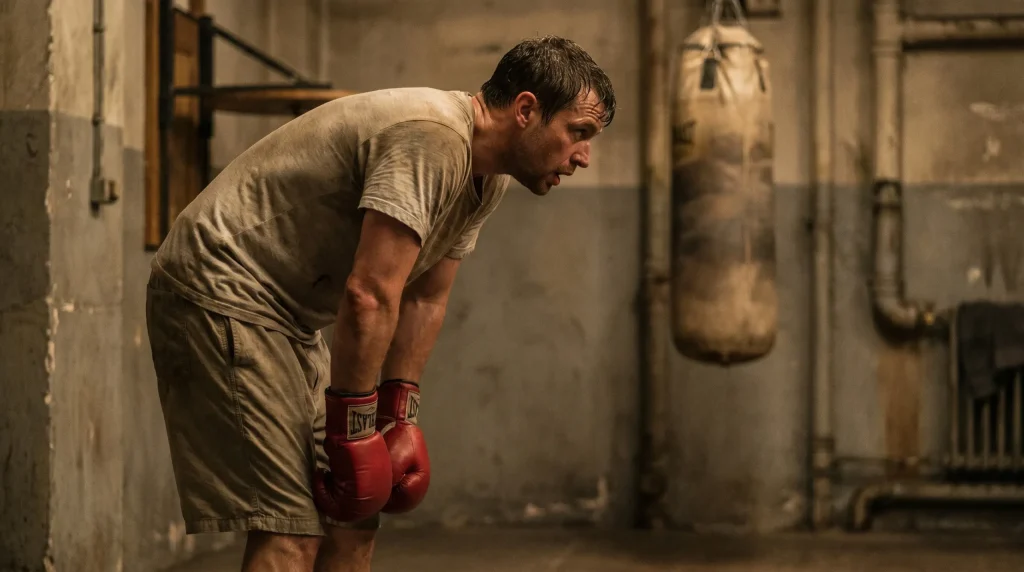
This is probably the most common mistake.
A beginner walks up to the bag, the timer starts, and the first 20 seconds look like a street fight with a leather cylinder.
Hard jab. Hard cross. Hard hook. Another hard cross. No movement. No breathing. No rhythm.
Then the shoulders burn, the hands drop, the punches get shorter, and the rest of the round becomes survival.
That is not a stamina problem yet. That is a pacing problem.
A heavy bag round should not start like a sprint unless sprinting is the goal of that round. Most of your bag work should be controlled enough that you can keep your form.
Try this instead:
First minute: light, clean punches
Second minute: steady pace
Last 20-30 seconds: push harder
That one change can make a huge difference.
You should not feel completely cooked halfway through round one. If you do, slow down. You are probably treating the warm-up round like a power test.
Breathing matters more than beginners think
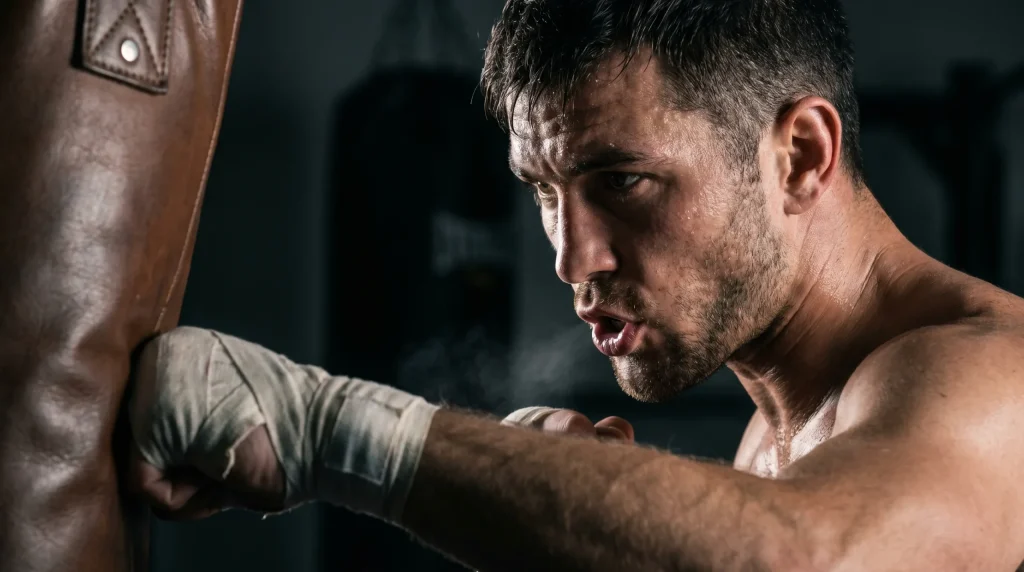
A lot of beginners hold their breath when they punch.
They do not always notice it. They just feel tired fast.
Breath-holding makes everything harder. Your shoulders tense up. Your punches get stiff. Your heart rate climbs. You feel like you are working way harder than you should be.
A simple rule:
Exhale when you punch.
Inhale when you reset.
Relax when you move.
You do not need to make loud noises every time you throw a jab. Some people do, and that is fine, but the main thing is that air is moving.
If you are not sure whether you are breathing, slow the round down.
Throw a jab and breathe out. Step. Breathe in. Throw the cross and breathe out. Reset.
It sounds basic because it is. But basic is usually what breaks first when beginners get tired.
Tension kills your gas tank
Watch a beginner hit the bag and you will often see the same thing:
jaw clenched
shoulders high
arms tight
hands squeezing the gloves
feet stuck in place
every punch forced
That burns energy fast.
You want to be sharp, not stiff. There is a difference.
Your hands should return to guard, but your arms should not feel like they are locked in concrete. Your shoulders should work, but they should not live next to your ears. Your feet should be ready to move, not glued to the floor.
A good cue is this:
Stay loose until the punch lands.
The punch snaps, then you relax again.
If you stay tense for the whole round, you are basically doing a shoulder endurance workout with boxing gloves on.
Not every punch should be a power shot
Power shots cost more energy.
That does not mean you should never throw hard. It means you should choose when to throw hard.
Beginners often try to hit every punch at 100%. The jab is 100%. The cross is 100%. The hook is 100%. Even the warm-up round is 100%.
That is a quick way to turn a 3-minute round into 45 seconds of chaos and 2 minutes of regret.
Use different gears.
For most beginner bag sessions:
Light technical work: 50-60%
Normal working pace: 70-80%
Power bursts: 90-100% for short moments
For example, you might spend most of the round moving and throwing clean combinations at a controlled pace. Then, near the end, you add a 10-second burst.
That is more useful than throwing ugly power shots for a full round.
Bag stamina and cardio are related, but they are not the same
Cardio helps. No question.
If your general conditioning is poor, bag work will expose it quickly. You need an engine. Running, cycling, jump rope, rowing, swimming, incline walking, or any steady cardio can help.
But bag stamina is not just general cardio.
You also need punching endurance. You need to keep your hands up. You need your legs under you. You need your core to stay active while you rotate and move. You need to breathe while throwing combinations.
That is why someone can run a decent distance and still gas out on the bag. Running helps the engine, but it does not teach you how to punch without wasting energy.
A better plan is to train both.
Do your bag rounds for boxing-specific conditioning.
Do some steady cardio outside bag work so you recover better between rounds and between training days.
And do some strength work so your shoulders, legs, and core can handle the work.
The CDC’s adult activity guidelines recommend both aerobic work and muscle-strengthening work across the week. That does not mean every heavy bag beginner needs a perfect fitness plan, but it does mean bag work alone should not be the whole program.
Build a full session, not just random rounds

If you gas out fast, do not only ask, “How many rounds should I do?”
If you don’t have a timer set up, use the Heavy Bag Pro free boxing timer for setting your rounds.
Ask, “What does my full session look like?”
A simple beginner session could look like this:
5-10 minutes warm-up
2 rounds shadowboxing
3-5 rounds heavy bag
1 minute rest between bag rounds
Optional strength work after
Easy cooldown
Warm-ups are not just filler. They help you ease into harder work instead of asking your body to go from zero to full power immediately. The American Heart Association recommends a gradual warm-up before moderate or vigorous exercise, often around 5-10 minutes.
Shadowboxing also matters.
It gives you a chance to move, breathe, loosen up, and rehearse the punches before the bag adds impact. If you cannot stay relaxed while shadowboxing, you probably will not stay relaxed on the bag.
Then hit the bag with a plan.
Do not just start swinging and hope the round becomes useful.
A simple heavy bag plan if you gas out fast
Try this for your next session.
Round 1: jab only
Keep it light. Move around the bag. Jab the head, jab the body, step in, step out. The goal is rhythm, not power.
Round 2: jab-cross
Stay relaxed. Bring your hands back. Breathe on both punches. Do not fall into the bag after the cross.
Round 3: basic combo
Use something simple like jab-cross-hook. Throw it clean, reset, move. Do not rush into long combinations.
Round 4: combo, then move
After every combination, step out or pivot. This teaches you not to stand still after punching.
Round 5: controlled pressure
Pick up the pace, but do not turn it into wild swinging. Add short bursts, then reset.
If you are brand new, do 3 rounds instead of 5.
If 2-minute rounds are too much, start shorter and build up.
The goal is not to suffer. The goal is to finish with better form than you started with.
How to know what kind of stamina problem you have
Not all “gassing out” feels the same.
If your lungs burn and you cannot recover between rounds, you probably need more aerobic work.
If your shoulders are on fire but your breathing is okay, you may be too tense, punching too hard, or not used to keeping your hands up.
If your punches get sloppy after 30-45 seconds, your pace is probably too high.
If you feel panicked and rushed, you need slower technical rounds.
If your hands drop every round, reduce the volume and focus on clean reps.
If your legs stop moving, add footwork and shadowboxing, not just more punching.
This matters because the fix changes depending on the problem.
More rounds are not always the answer.
If the round is bad, adding more bad rounds just gives you more bad practice.
What to do outside the bag
If you want better gas tank on the bag, add easy cardio.
Nothing complicated.
Do 2-3 easy cardio sessions per week if your schedule allows it.
Jogging, cycling, jump rope, rowing, swimming, brisk walking, anything that gets your heart rate up and that you can repeat consistently.
Keep most of it easy enough that you are not destroying your legs for the next bag session.
Then add basic strength training.
Push-ups, squats, rows, lunges, planks, sit-ups, loaded carries if you have weights. You do not need a bodybuilding program to improve your bag work. You just need a stronger body that can hold position and repeat quality movement.
If you already train in a boxing gym, lift, run, or play another sport, do not pile hard bag rounds on top of everything without thinking. Use some bag sessions for technique. Not every session has to be a conditioning test.
Progress slowly

A beginner mistake is changing too many things at once.
They go from 3 rounds to 8 rounds.
Then they make every round 3 minutes.
Then they throw harder.
Then they add jump rope, sprints, and strength training.
A week later, everything hurts.
Progress one thing at a time.
Add one round.
Or make one round longer.
Or add one harder burst.
Not all three in the same week.
A good beginner target is simple:
2-3 bag sessions per week
3-5 bag rounds per session
2-minute rounds to start
1-minute rest between rounds
Once that feels clean, move some rounds to 3 minutes.
Clean 2-minute rounds are better than ugly 3-minute rounds.
Final answer: Why do you gas out so fast
You gas out because heavy bag work exposes everything at once.
Your cardio. Your pacing. Your breathing. Your tension. Your technique. Your shoulder endurance. Your ability to stay calm under fatigue.
That is why the fix is not just “do more rounds.”
The fix is:
Warm up properly.
Shadowbox first.
Start slower.
Breathe on every punch.
Stop throwing everything at full power.
Use simple rounds with a clear goal.
Do cardio outside the bag.
Add basic strength work.
Build up slowly.
If you train alone, structure matters even more. Heavy Bag Pro was built around that exact problem: most people do not need more random bag time, they need guided rounds that tell them what to work on next.
Getting tired is normal.
Falling apart after 45 seconds every round is usually not a character flaw.
It usually means your round needs a better plan.